Cleansing Fire Has Moved...

www.cleansingfiredor.com


All new blog posts will appear there, so update your bookmarks and live feeds. If you would like to post a comment to one of the older articles, please do so on the new site. Thank you, and God bless!

Friday, November 13, 2009

The Martyrdom of St. John Fisher

While we're on the subject of noble deaths, none can be more spiritually noble than that of St. John Fisher. I'm sure that by this point in time, many of you would have availed yourselves of the opportunity to watch the dramatized execution in the dedication portion to the right. However, this literary description is truly beautiful and deserves your consideration, as well.


His lips were moving in prayer, as they carried him to Tower Hill. And when they reached the scaffold, the rough men of his escort offered to help him up the ladder. But he smiled at them: "Nay, masters, now let me alone, ye shall see me go up to my death well enough myself, without help." And forthwith he began to climb, almost nimbly. As he reached the top the sun appeared from behind the clouds, and its light shone upon his face. He was heard to murmur some words from Psalm 33: Accedite ad eum, et illuminamimi, et facies vestræ non confundentur. The masked headsman knelt - as the custom was - to ask his pardon. And again the cardinal's manliness dictated every word of his answer: "I forgive thee with all my heart, and I trust on Our Lord Thou shalt see me die even lustily." Then they stripped him of his gown and furred tippet, and he stood in his doublet and hose before the crowd which had gathered to see his death. A gasp of pity went up at the sight of his "long, lean, slender body, nothing in manner but skin and bones ... the flesh clean wasted away, and a very image of death, and as one might say, death in a man's shape and using a man's voice." He was offered a final chance to save his life by acknowledging the royal supremacy, but the saint turned to the crowd, and from the front of the scaffold, he spoke these words:

"Christian people, I am come hither to die for the faith of Christ's Catholic Church, and I thank God hitherto my courage hath served me well thereto, so that yet hitherto I have not feared death; wherefore I desire you help me and assist me with your prayers, that at the very point and instant of my death's stroke, and in the very moment of my death, I then faint not in any point of the Catholic Faith for fear; and I pray God save the king and the realm, and hold His holy hand over it, and send the king a good counsel."

The power and resonance of his voice, the courage of his spirit triumphing over the obvious weakness of his body, amazed them all, and a murmur of admiration was still rustling the crowd when they saw him go down on his knees and begin to pray. They stood in awed silence while he said the Te Deum in praise of God, and the Psalm [70] In Thee O Lord have I put my trust, the humble request for strength beyond his own. Then he signed to the executioner to bind his eyes. For a moment more he prayed, hands and heart raised to heaven. Then he lay down and put his wasted neck upon the low block. The executioner, who had been standing back, took one quick step forward, raised his axe and with a single blow cut off his head. So copious a stream of blood poured from the neck that those present wondered how it could have come from so thin and wasted a frame. There was certainly divine irony in the fact that 22 June, the date of the execution, was the Feast of St. Alban, the first Martyr for the Faith in Britain. If the king had realized this he would certainly have arranged for the execution of Cardinal Fisher to take place on another day.

Tridentine Latin Mass at Holy Spirit Church

Sorry for the late notice, but there will be a Tridentine Latin Missa Cantata at Holy Spirit Church on Saturday, the 14th at 8 a.m. The celebrant will be Father Gerard McMahon. The church is located at the corner of Plank and Hatch Road in Penfield. The ordinary and propers of the Mass will be sung by Schola Roffensis, directed by Joel Morehouse.

Thursday, November 12, 2009

Link to British Catholic Blogs

Falling in line with our British theme here at CF, I found a link for British Catholic blogs.

http://britcat.blogspot.com/

Here is a link to a Monarchy blog.
http://themonarchist.blogspot.com/


TTFN!!

Just, and Firm of Purpose Are We

I thought that, given our new heading and the quotes thereon, we should look for a moment at some of the unsung martyrs of the past century. Though you may say, "Hey, this is English Month, not Russian Month," I should like to remind you that these Orthodox souls were related to the English royal family. Who am I talking about?

Why, none other than the Romanov family, the line of czars that ruled Russia for three hundred years. While many people know that the Russian royal family was deposed and executed in the Russian or "Bolshevik" Revolution, few know that the Czar, his wife, their five children, and four household servants were canonized in the Russian Orthodox Church which, in a sense, makes them "half-saints" of the Catholic Church. We may not have been the actual "canonizers," but I think we in the Latin Church can still appreciate the trials they went through and which contributed to their being named "Passion Bearers" for Christ in recent years.

Here is a summary of the last few days of the Romanov family:

"Gradually these guards were humanised by contact with their prisoners. They were astonished at their simplicity, attracted by their gentleness, subdued by their serene dignity, and soon found themselves dominated by those whom they thought they held in their power. The drunken Avdiev found himself disarmed by such greatness of soul; he grew conscious of his own infamy. The early ferocity of these men was succeeded by profound piety."

When this would happen, the inhuman Bolsheviks would replace the guards who had been so touched with crueller and more animalistic ones.

Seldom being allowed to go to church, they nevertheless nourished their souls with home prayers and greatly rejoiced at every opportunity to receive the Divine sacraments. Three days before their martyrdom, in the very house in which they were imprisoned, there took place the last church service of their suffering lives. As the officiating priest, Fr. John Storozhev, related: "'It appeared to me that the Emperor, and all his daughters, too, were very tired. During such a service it is customary to read a prayer for the deceased. For some reason, the Deacon began to sing it, and I joined him... As soon as we started to sing, we heard the Imperial Family behind us drop to their knees' (as is done during funeral services)... Thus they prepared themselves, without suspecting it, for their own death - in accepting the funeral viaticum. Contrary to their custom none of the family sang during the service, and upon leaving the house the clergymen expressed the opinion that they 'appeared different' - as if something had happened to them."

The Tsaritsa (wife of Nicholas II, the czar) used to say:

"We are one, and this, alas, is so rare today. We are tightly united together... a small, tightly knit family..."

Inseparable in life, they were now to remain unseparated in death.

After midnight on July 4/17, 1918, the entire family, with their doctor and two faithful servants, was brought to the basement of the house of their confinement under the pretext of moving them once again. There they were brutally and mercilessly murdered, the children as well as the adults, under the cover of darkness - for "men loved the darkness rather than light, because their deeds were evil" (John 3.19). The Tsar was shot as he stood forward to defend his family. Tsaritsa Alexandra was able to make the sign of the Cross before she, too, fell. The first bullets did not bring death to the youngest ones, and they were savagely clubbed, bayoneted and shot at point-blank range.

Those killed were: the Tsar (born 1868), the Tsaritsa (1872), Olga (both 1895), Tatiana (1897), Maria (born 1899), Anastasia (born 1901), Alexis (born 1904), the Tsar's physician Eugene Botkin, the Tsaritsa's chamber-maid Anna Demidova, the cook Kharitonov and the servant Trupp. The sailor Clement Nagorny, who had looked after the Tsarevich since early childhood, and Sergius Sednev, the servant to the Grand Duchesses, both of whom had defended the Royal Family from robbery and insults in Ekaterinburg, were taken away to prison and shot there. Those who were refused permission to stay with the Royal Family at Ekaterinburg, and who were also shot in prison were General Elias Tatishchev and Prince Basil Dolgorukov. The maid-of-honour, Countess Anastasia Hendrikova, and the court teacher, Ekaterina Schneider, were taken to Perm and shot there.

The Romanovs, as history has been able to remove the spin of Soviet Russia, have been put in a different light. Nicholas did not delight in the sufferings of his people - he wished to join them in suffering. They lived in opulence - but they also gave much to their country and much to God. The royal family would often meet trains of troops going to the front in WWI, and hand each soldier, personally, a prayer card.

There are accounts of Alexei, the son of the Czar and a hemophiliac, fighting from his sick bed with a guard who attempted to steal his Chotki, an Orthodox version of the Rosary.

If only all royalty would have had such courage and love for their faith!

A Nod of the Miter Goes to . . .

. . . the Crescat, for this hilarious little snippet:

New Header - Feedback?

I'm trying out a new header, as you can plainly see.

Comments? Critiques? Suggestions?

Please let me know. Send an email to cleansingfire@live.com or just leave a comment below.

Wednesday, November 11, 2009

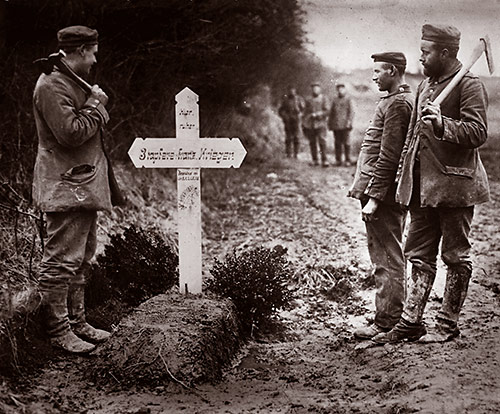
Veterans Day - Armistice Day


Few people actually understand why Veterans' Day is celebrated on November the Eleventh. On November 11, 1918, at 11 AM, the First World War effectively ended with the signing of an Armistice agreement between the Central Powers (Germany, Austria-Hungary, Ottoman Empire) and the Allied Powers (Great Britain, France, Italy, United States, Japan). In honor of the millions who have died unsung deaths is this poem dedicated:

It is the Soldier, not the minister
Who has given us freedom of religion.

It is the Soldier, not the reporter
Who has given us freedom of the press.

It is the Soldier, not the poet
Who has given us freedom of speech.

It is the Soldier, not the campus organizer
Who has given us freedom to protest.

It is the Soldier, not the lawyer
Who has given us the right to a fair trial.

It is the Soldier, not the politician
Who has given us the right to vote.

It is the Soldier who salutes the flag,
Who serves beneath the flag,
And whose coffin is draped by the flag,
Who allows the protester to burn the flag.

-Charles M. Province

"Come, Come Ye Sons of Art Away!"


After eleven days of reveling in renaissance polyphony, I should like to inaugurate the second part of "Everything English Month." This next set readings and musical selections come from the years after the English Civil War, anti-Catholic legislation passed by Puritans, and the "Glorious Restoration" of the English monarchy in 1660. We pick up our exploration in the era now typically called "Baroque."

The first dose of Anglo-Catholic/Roman-Catholic Baroqueness will be a selection of pieces from the illustrious composer Henry Purcell, who lived from 1659 until 1695, preceding Handel, whose work we shall hear later this month. Enjoy!

One piece featured in the music bar to the right is "Come Ye Sons of Art Away," and adroitly describes the sentiment of Rochester Catholics when the countdown reaches 0 . Even though Purcell himself wasn't a Catholic, I think we can all agree he got music spot on, if not doctrine. The lyrics are:

Come, come ye sons of art, come, come away.

Tune all your voices and instruments play,
To celebrate, to celebrate this triumphant day.

Tune all your voices and instruments play,
To celebrate, to celebrate this triumphant day.

Tuesday, November 10, 2009

SLAP - Survivors of Liturgical Abuse in Parishes

SLAP is an international organization trying to recover some semblance of sanity in parishes with regard to the sacred Liturgy.Join up and tell your story.

http://www.facebook.com/group.php?gid=163446277798&ref=nf

From Father Z's blog, here is a parody on "Gather Us In"

Here in this place, our comfortable parish,
All of the statues carried away,
See in each face a vacuous visage,
Brought here by guilt or by R.C.I.A.

Gather us in, by Beemer or Hummer,
Gather us in, so we can feel good,
Come to us now in this barren Zen temple,
With only a shrub and an altar of wood.

We are the young, our morals a mystery,
We are the old, who couldn’t care less,
We have been warned throughout all of history,
But we enjoy this liturgical mess.

Gather us in, our radical pastor,
Gather us in, our unveiled nun,
Call to us now, with guitars and bongos,
Hang up your cellphones and join in the fun!

Next High Mass @ St. Stanislaus

The next High Mass at St. Stanislaus will be November 22 at 1:30 p.m. The church is at the corner of Hudson Avenue and Norton Street. Free parking can be had in the parking lot off of St. Stanislaus Street, or on Hudson Avenue or the church parking lot on Northeast Avenue. There will be security guards patrolling the lots, restrooms are in the back of church, the handicapped elevator is on the north side of the church. Confessions will be heard after Mass.

The choir will sing Victoria's "O Magnum Mysterium" for the ordinary parts of the Mass. The schola will sing the Gregorian propers.

The choir motets will be "Miserere" by Antonio Lotti and Claudio Monteverdi's 6-part motet "Domine, ne in furore".

Here are previews of both motets.


and the Monteverdi --


By tradition, the Church dedicates each month of the year to a certain devotion. In November, it is the Holy Souls in Purgatory, those faithful Christians who have died and gone before us but who still must atone for their sins. The time they spend in Purgatory cleanses them so that they may enter Heaven free from all effects of sin.

Praying for the dead, especially for those we have known, is a requirement of Christian charity. Our own prayers and sacrifices can be offered up to relieve their suffering.

Please try and attend the High Mass in order to pray for the relief of the souls in Purgatory.


The Trial of St. Thomas More

In honor of our continuing "All Things English Month," I have deigned it wholly appropriate and necessary to post the following clips from A Man for All Seasons. It focuses on the trial of St. Thomas More, and is, from what I have read on the matter, rather accurate.


For The Sake of Solidarity


I received an email from one of my friends who clicks "Forward to everyone" at least five times per day. Usually, that's pretty annoying. However, this email was somewhat thought-provoking. In it, the original author noted how in the Oklahoma City bombing of 1995, Timothy McVeigh, "a Roman Catholic from Lockport, New York," was responsible for a massive loss of life. The message goes on to ask that all people, for the sake of solidarity, not hold Muslims culpable for the heinous acts of the one individual who went on a murderous rampage at Fort Hood. I agree with that, however I think it's interesting how the argument works: A man who happens to be Catholic blows up a building because of his contempt for the government compared to a man who yells Allahu Akbar before killing American soldiers because, in his opinion, "Muslims need to stand up and wage jihad against America." I have nothing but compassion for the worldwide Muslim community who may be targeted by ignorant and closed-minded individuals, but I think we need to stop dancing around the facts:

A Muslim committed an act of terrorism because his interpretation of his faith led him to do so.

One need not say that this interpretation of the Qur'an was flawed - that's too obvious for words. I sincerely hope that, for the true sake of solidarity, all who read this blog offer a few moments of prayer for the perpetrator, those of his faith who will now suffer unduly, and those among us who have nothing but contempt for Islam. The Catholic Church holds that all faith has some measure of Truth within it, but that some faiths contain more Truth than others. As Catholics we must, as I have said time after time, hate the sin but love the sinner. While Islam has tended to be a religion more of subjugation of others, not subjugation to God, many Muslims have done noble things for the world. Pray for them as we pray for all people: that they may, in time, see the whole Truth of God and His Church. After all, as Our Lord Himself says, we cannot come to the Father but through the Son.

Monday, November 9, 2009

British Weather Forecast using Anglican chant motif

Photo Caption Contest #8

Here's a new photo for your caption-making delight. The original title was "Whispering Altar Boys." Remember, the winner gets five free Cleansing Fire prayer cards! Check back often!

Sunday, November 8, 2009

Fishers of Men Videos

These vocation videos were put out by the USCCB. They are excellent. You may have seen them before but they are definitely worth watching again. If you know any young men that might make a good priests, have them watch them. Please pray that our diocese gets many, many more vocations to the priesthood.

Part One


Part Two

Saturday, November 7, 2009

Flu Concerns at OLV

At First Friday Mass yesterday and at Holy Saturday Mass today at Our Lady of Victory, an announcement was made not to "touch hands," per Father Antinarelli. It was suggested that we nod or wave peace to each other. I just want to "shake Father's hand," but I guess I can't.

The Death of Mary Stuart, Queen of Scots

The following comes from eyewitnesshistory.com.

"On February 7, 1587, the representatives of the English Queen, reached the Castle of Fotheringay, where the Queen of Scotland was confined at that time, between two and three o'clock in the afternoon. In the presence of her jailer, Paulet, they read their commission regarding the execution of the prisoner, and said that they would proceed with their task the next morning between seven and eight o'clock. The jailer was then ordered to have everything in readiness.

Without betraying any astonishment, the Queen thanked them for their good news, saying that nothing could be more welcome to her, since she longed for an end to her miseries, and had been prepared for death ever since she had been sent as a prisoner to England. However, she begged the envoys to give her a little time in which to make herself ready, make her will, and place her affairs in order. It was within their power and discretion to grant these requests. The Count of Shrewsbury replied rudely:

'No, no, Madam you must die, you must die! Be ready between seven and eight in the morning. It cannot be delayed a moment beyond that time.' "

Mary spent the rest of the day and the early hours of the next morning writing farewell letters to friends and relatives, saying goodbye to her ladies-in-waiting, and praying. We rejoin de Bourdeille's account as Mary enters the room designated for her execution and is denied access to her priest:

"The scaffold had been erected in the middle of a large room. It measured twelve feet along each side and two feet in height, and was covered by a coarse cloth of linen.

In Captivity
The Queen entered the room full of grace and majesty, just as if she were coming to a ball. There was no change on her features as she entered.

Drawing up before the scaffold, she summoned her major-domo and said to him:

'Please help me mount this. This is the last request I shall make of you.'

Then she repeated to him all that she had said to him in her room about what he should tell her son. Standing on the scaffold, she asked for her almoner, (chaplain) begging the officers present to allow him to come. But this was refused point-blank. The Count of Kent told her that he pitied her greatly to see her thus the victim of the superstition of past ages, advising her to carry the cross of Christ in her heart rather than in her hand. To this she replied that it would be difficult to hold a thing so lovely in her hand and not feel it thrill the heart, and that what became every Christian in the hour of death was to bear with him the true Symbol of Redemption."

Standing on the scaffold, Mary angrily rejects her captors' offer of a Protestant minister to give her comfort. She kneels while she begs that Queen Elizabeth spare her ladies-in-waiting and prays for the conversion of the Isle of Britain and Scotland to the Catholic Church:

"When this was over, she summoned her women to help her remove her black veil, her head-dress, and other ornaments. When the executioner attempted to do this, she cried out:

'Nay, my good man, touch me not!'

But she could not prevent him from touching her, for when her dress was lowered as far as her waist; the scoundrel caught her roughly by the arm and pulled off her doublet. Her skirt was cut so low that her neck and throat, whiter than alabaster, were revealed. She concealed these as well as she could, saying that she was not used to disrobing in public, especially before so large an assemblage. There were about four or five hundred people present.

The executioner fell to his knees before her and implored her forgiveness. The Queen told him that she willingly forgave him and alI who were responsible for her death, as freely as she hoped her sins would be forgiven by God. Turning to the woman, to whom she had given her handkerchief, she asked for it.

She wore a golden crucifix, made out of the wood of the true cross, with a picture of Our Lord on it. She was about to give this to one of her women, but the executioner forbade it, even though Her Majesty had promised that the woman would give him thrice its value in money.

After kissing her women once more, she bade them go, with her blessing, as she made the sign of the cross over them. One of them was unable to keep from crying, so that the Queen had to impose silence upon her by saying she had promised that nothing of the kind would interfere with the business in hand. They were to stand back quietly, pray to God for her soul, and bear truthful testimony that she had died in the bosom of the Holy Catholic religion.

Execution
One of the women then tied the handkerchief over her eyes. The Queen quickly, and with great courage, knelt dawn, showing no signs of faltering. So great was her bravery that all present were moved, and there were few among them that could refrain from tears. In their hearts they condemned themselves far the injustice that was being done.

The executioner, or rather the minister of Satan, strove to kill not only her body but also her soul, and kept interrupting her prayers. The Queen repeated in Latin the Psalm beginning In te, Damine, speravi; nan canfundar in aeternum. When she was through she laid her head on the block, and as she repeated the prayer, the executioner struck her a great blow upon the neck, which was not, however, entirely severed. Then he struck twice more, since it was obvious that he wished to make the victim's martyrdom all the more severe. It was not so much the suffering, but the cause, that made the martyr.

The executioner then picked up the severed head and, showing it to those present, cried out: 'God save Queen Elizabeth! May all the enemies of the true Evangel thus perish!'

Saying this, he stripped off the dead Queen's head-dress, in order to show her hair, which was now white, and which she had been afraid to show to everyone when she was still alive, or to have properly dressed, as she did when her hair was fair and light.

It was not old age that had turned it white, for she was only thirty-five when this took place, and scarcely forty when she met her death, but the troubles, misfortunes, and sorrows which she had suffered, especially in her prison."

Friday, November 6, 2009

Goodbye Bad Bishop

Found in the Remnant Newspaper - Guess who is listed first.

http://www.goodbyebadbishops.com/

Thursday, November 5, 2009

Margaret Thatcher on Socialism

Nod of the miter to "Little Gimli the Dwarf" for sharing this video.


The Tudor Truth and Protestant Perpetrations Part II


Last time we spoke of the Tudor Truth and Protestant Perpetrations, I noted that we would begin next time with "battle lines being drawn." Well, no better way to do this than to show that the current debate about Canon Law and Lay Involvement (which shouldn't be a debate because Rome has spoken) was just as wide-spread in the 16th Century as it is now. Note that back then, this resulted in murder, intrigue small-scale genocide and a general loathing of anything Traditional.

Lay Supremacy:
Reform of the canon law of England from Henry VIII to
Elizabeth I (1529-1571)

Lay Supremacy
From the very outset the reform of the canon law was driven first and foremost
by the constitutional necessity inherent in Henry VIH s claim to the
title of headship in relation to the Church of England. In the preface to his
edition of the Reformatio, John Foxe briefly recounts the tortuous history of
efforts to constitute the Royal Commission which eventually drafted the text
of the revised code presented to Parliament by Thomas Cranmer in 1553.
The earliest suggestion for such a committee originated with the clergy in
Convocation more than twenty years earlier in the midst of political manoeuvres
surrounding Henry's quest for a divorce from Queen Catherine—
"the King's great matter." In 1529 the first in a series of statutes was passed
by Parliament denouncing papal authority as a usurpation of the traditional
jurisdiction of the English ecclesiastical courts, and reasserting the doctrine
of the late-fourteenth century Statutes of Praemunire." Clearly recognizing
the anti-papal writing on the wall, the clergy in Convocation initiated a preemptive
attempt at a systematic overhaul of the canon law four years before
the break with Rome was formally sealed.' The canon law together with
its complex apparatus of courts, procedures, and precedents was so closely
bound up with papal authority that the flexing of royal claims to supreme
ecclesiastical jurisdiction provided an irresistible impetus to constitutional
and legal reform.

On 28 April 1532, in the Answer of the Ordinaries,' the English hierarchy
defended for the last time their constitutional status to conduct their affairs
independently of the civil power. A fortnight later on 16 May, the bishops
voted a formal Act of Submission' which they presented to Henry. In their
submission they promised not to make or promulgate any new ecclesiasticallaws without the license and assent ofthe Sovereign, thus eflFectively abjuring
the papal supremacy. The bishops also offered the entire corpus of the canon
law for royal evaluation by a committee of Parliament. The 'Act of Submission
ofthe Clergy' contains the first reference to a Commission of thirty-two
members charged with the reform of the canon law of England, although
twenty years were to elapse before concrete action was taken to this end (note: the letter "r" often appears as "t"):
So that finally whichsoever ofthe said constitutions, ordinances ot canons ptovincial ot synodal shall be thought and detetmined by yout grace, and by the most patt ofthe said thitty-two persons, not to stand with God's laws, and the laws ofthe tealm, the same to be abtogated and taken away by yout gtace, and the cletgy. And such of them as shall be seen by yout gtace, and by the most patt of the said thitty-two persons to stand with God's laws, and the laws of yout tealm, to stand in full strength and powet, yout grace's most toyal assent and authority once obtained fully given to the same."

In rapid succession Archbishop Warham died (August 1532); Cranmer
was appointed his successor to the see of Canterbury; Henry married Anne
Boleyn (25 January 1533); Henry's marriage to Catherine of Aragon was pronounced
invalid (23 May 1533); Anne was crowned Queen (1 June 1533);
and Henry was excommunicated by Clement VII on 11 July 1533.''' The
thread of hierarchy which linked England through the papacy to the sacramentally
interconnected framework of Christendom was cut. Confirming
the new constitutional reality of royal ecclesiastical supremacy, the 'Act in
Restraint of Appeals' passed by Parliament in 1533 declares England to be an
'empire,' Henry's crown 'imperial,' and dissolves all juridical ties to the see of
Rome on the ground that the English Church is 'sufficient and meet of itself,
without the intermeddling of any exterior person or persons.''

To Bishop Clark, From His Humble Servants:

"Prince of degredations, bought and sold,
These verses, written in your crumbling sty,
Proclaim the faith that I have held and hold,
And publish that in which I mean to die."