Cleansing Fire Has Moved...

www.cleansingfiredor.com


All new blog posts will appear there, so update your bookmarks and live feeds. If you would like to post a comment to one of the older articles, please do so on the new site. Thank you, and God bless!

Friday, April 30, 2010

A Masterful Defense of Our Sovereign Pontiff

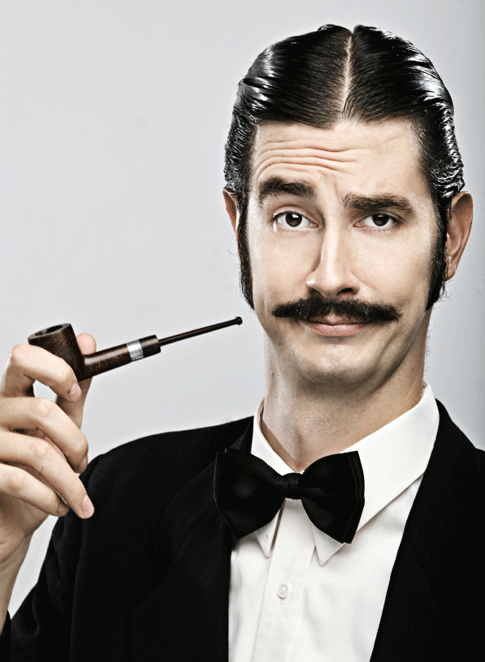
The following is an excerpt from the National Review. This piece definitely deserves your full attention, and also, a full read. The entire piece can be found here. The photo below also appeared on the National Review website as an ad.

May God bless these people who willingly and lovingly tell it like it is.

It has been disappointing and irritating (but not surprising) that the New York Times has tried to set this controversy up as another Watergate, and with po-faced sanctimony reports each new weekly, unsubstantiated allegation of deviant clerical abuse in Moldova, Fiji, Timbuktu, Patagonia, and assumedly, the Moon. It wished to make it a war of a thousand cuts, escalating steeply and swiftly, on the Watergate pattern, to the destruction of the pope himself: the drumfire of endless outrage confected and displayed with pseudo-grave neutrality, from which debouches the tribal move to execute the chief. “The king must die”; regicide as tokenism, as liberal group therapy.

. . . 
Benedict XVI has declared the Church to be ashamed and penitent, has met with victims’ and their families, has expedited investigative and corrective procedures, has opened up access for complainants, and has imposed fail-safe strict controls, without delivering his clergy to the howling cannibals. He has handled it all like the great, scholarly, courageous, and profoundly civilized man he is, with humility, dignity, and effectiveness. He should now decree a reasonable deadline for past complaints and start to lead the Church out of the fire, and close down the decades-long turning of the spit that the Church’s enemies had been ghoulishly preparing.

As the pope tries to amputate what is bad, the Church’s enemies are trying to take advantage of that process to destroy the entire institution. This too is a pattern. Pius XII’s wartime performance was quite inadequate, but he did save 850,000 Jews, as is now coming to light. No one else did that. This child-abuse crisis is shameful and evil and disgusting. Only the Church can stop, punish, confess, repent, and prevent recurrence, all on the scale required. It is doing so, late and over-cautiously. But secular witch-hunts and lynchings are not part of the solution, and if they continue, it may be almost time for a few Counter-Reformationist measures. The scorching unction of the Church’s more rabid enemies might become more bearable to them if the Church’s adherents reconsidered their advertising budgets. In the case of the Times, its guardian angel, Señor Slim, would surely fly to its aid again with another infusion of 14 percent yield, usurers’ junk bonds.

Easter Season Marches On

I just wanted to remind all of you that we are still in the Season of Easter, and we will be until Pentecost Sunday. In keeping with the rejoicing spirit of this holy season, I present for your viewing pleasure the following video, recorded at the 2008 Bach-fest in Germany.


Thursday, April 29, 2010

Changing of the Guard

The following is taken from the people at US Catholic. Seeing as how they use our work and do not link, we will not extend a courtesy refused to us. Smack of the crozier at self-centered liberals.

My commentary added, as usual.

When the alarm clock rings, Father James Moore, 33, pops out of bed. He brews coffee, makes his bed, and launches into prayer.
Down the hall, Father Bart Hutcherson, 48, likes to set two alarms half an hour apart to ease into the morning. He doesn’t bother making his bed.  
Their days, their desks, and their general approaches to priesthood differ widely. Yet they are both Dominican priests serving the same parish, St. Thomas More Catholic Newman Center in Tucson, Arizona.
When they are standing side by side on Sunday, the contrast is clear. Father Bart wears a simple white habit, a green chasuble, and sandals (AKA "Hippie"). Father James wears the same habit and chasuble, along with an alb, an amice, and black shoes (AKA "priest"). He looks fancier, yet he is the associate to Father Bart, who considers his junior’s dress “overkill.”(There is nothing overkill about looking like a priest. The only thing which is "overkill" is the older priest's dated demeanor and liberal taint.)
The amice “is truly a pre-Vatican II vestment, not required in any circumstances,” he says. “Here in the desert, it makes little sense to put on an extra layer of clothes.”(It's not about comfort, it's about the liturgy. It's one thing which was discarded needlessly, and without any formal decree. It was one more casualty of the "Spirit of Vatican II," a spirit which the older priest obviously professes.)
So it is no surprise, with clothing differences that translate into liturgical ones, that parishioners wondered what would ensue when Father James—fresh out of seminary (It's the young ones who are loyal) —was assigned to assist their more casual pastor.
“Father James led such a sheltered life, growing up in a traditional Catholic family in the country, so he shows up at the Newman Center and he’s all set and ready to fight the good fight,” (I don't care for this fellow's tone. So what if he's from the country? John Paul II acted the same way, but grew up in a big city, Krakow. Oh, but that's right, we don't have to examine anything before Vatican II, because it's all irrelevant.) says parishioner Cliff Bowman, 45, a pilot instructor and father of four (what lofty credentials to judge a newly-ordained priest). “I was a little concerned how they were going to work out.”
The two priests had the same questions. Father Bart had just attended Father James’ ordination, “a very high-church liturgy at a big Gothic church”—a far cry from the informal Newman Center where, alas, the avid organist would have no organ. “That was my first impression: How is he going to survive here without an organ? And is he going to push us to try to get an organ?” (What a shallow interpretation of being a lover of the liturgy.) Father Bart recalls. “I knew his liturgical style is much more high church than mine, so I worried, how is that going to affect our ministry here? Is that going to be something that’s a sadness for him? Or is it going to be something where he comes in and tries to change the dynamic here?”
Father James had no plans for a takeover, but he did bring a penchant for Gregorian chant, a knowledge of Latin, and a “curiosity as to how it would play out.”(Sounds like a tyrant to me. Not.)
How is it playing out two years later? “Pretty well,” Bowman says, which is remarkable when you line the two men up and break down their differences. The short list is the stuff they have in common: the Dominican formation, the Newman mission, the commitment to priesthood and service.
The list of differences is virtually everything else, beginning with where they preach, how they preach, and what they preach on. Father James uses a prepared text and stands at the lectern; Father Bart leaves the lectern and the script. Father James addresses morality, church teaching, and church history, while Father Bart applies scripture to everyday challenges and temptations (note the difference between what a homily should be, and what the homily is for the older priest).
Even the way they position their hands at Mass reflects broader discrepancies: Father Bart folds one hand over the other, palms facing his chest (and liberals call orthodox liturgists effeminate??), while Father James presses his hands together, fingers pointing up.

Changing of the guard

As a younger generation of priests joins and replaces an older generation, parishes across the country are feeling the change (God forbid.). City by city, diocese by diocese, it is a changing of guards that is neither swift nor soundless and comes with no choreography to guide the steps.
Many young priests arrive with an unabated zeal for the church, a solid grasp of liturgical rubrics, and a preference, if not insistence, for traditions of the past (If it were me, it would be insistence, not "preference." We are seeing young men coming in who aren't the liberal pushovers we have now [or the liberal tyrants]). They call themselves “JPII priests” because their formative years were shaped by Pope John Paul II’s pontificate. They are unafraid to preach on touchier moral teachings and eager to share rituals they consider timeless—ones their gray-haired peers often interpret as a step backward from the hard-won changes of the Second Vatican Council.("Hard-won changes"? The changes these liberals cling to are not genuine results of the council - they have contrived them out of the haughtiness of their hearts.)
For these older priests, zeal for the church has softened into an abiding love, tinged by an awareness of its shortcomings. They’ve seen many messy relationships, and they’ve mastered the fine art of meeting people where they are and gently drawing them in.(And new priests can't do this? How do these people think the Church existed before Vatican II?)
At best, the change can puzzle parishioners, surprised at how different the same vocation can look. It can result in awkward moments—a parishioner sitting between a pastor and an associate pastor engaged in a tense debate at a council meeting, or seeing the older priest roll his eyes and reference “the young buck.”
At worst, it can induce an exodus of parishioners. (Show me one parish that has suffered because of orthodoxy. Name one.) When the old priest and the new priest are diametrically opposed, Catholics say it can feel as if the axis of a familiar home church is tilting, the ground moving beneath their feet.
It’s “jarring,” says Mary Deeley, the pastoral associate at the Sheil Catholic Center in Evanston, Illinois. “Whenever you have a change in leadership, there are going to be people who say, ‘I just can’t do this. I’m out because he’s out.’ ”
On a personal level, that can result in a crisis of faith—someone who stops going to Mass or someone who never comes back.(So the author isn't a practicing Catholic? I wouldn't want to infer the wrong thing, but that's what it sounds like to me. How can someone who "stops going to Mass" actually write about this with any semblance of credibility?)
That major decision can be prompted by minor liturgical changes, which parishioners quickly pick up on and often read into, says Karon Latham, who has worked as a pastoral associate and now serves as director of faith formation for a cluster of three parishes in rural Central Michigan. “The liturgy is the heart of who we are and what holds us together as Catholics,” she says. “Any time there is an abrupt change in the way [liturgy] is done, it can really interfere with the way people are encountering God.”(It can interfere with the way people think they're encountering God. Would you not rather have a spotless liturgy than a familiar one? We are called to strive towards perfection, not to settle for what's easy, common, or understandable. The Mass is above all that, and should be approached as such. That means no sandals and more amices.)
There's more of this, but it's just the same liberal buzzwords over and over again. I have better things to do than to destroy liberals and their weak arguments.

Why I Stick to Limericks

Rocking the Boat

Rocking the Boat Barque of Peter is, from what I can gather from this video, a favorite hymn at Spiritus Christi.

Pontifical High Mass - Part II


The following is taken from Fish Eaters, and would prove beneficial to anyone unaccustomed with this amount of liturgical dignity. The truly moving thing here in the photos is that you will notice that, along with the properly vested ministers, the laity are dressed modestly and respectfully.

Keep in mind that this is written from a strictly Latin Mass perspective - however, much of it can and should be transferred to our practices at the Ordinary Form liturgies we attend.


The basic idea of how we should behave in Church is summed up by the Second Council of Lyons, A.D. 1274:


It is fitting that He Whose abode has been established in peace should be worshipped in peace and with due reverence. Churches, then, should be entered humbly and devoutly; behaviour inside should be calm, pleasing to God, bringing peace to the beholders, a source not only of instruction but of mental refreshment. Those who assemble in church should extol with an act of special reverence that Name which is above every Name, than which no other under Heaven has been given to people, in which believers must be saved, the Name, that is, of Jesus Christ, Who will save His people from their sins. Each should fulfil in himself that which is written for all, that at the Name of Jesus every knee should bow; whenever that glorious Name is recalled, especially during the sacred Mysteries of the Mass, everyone should bow the knees of his heart, which he can do even by a bow of his head. In churches the sacred solemnities should possess the whole heart and mind; the whole attention should be given to prayer.


Attire


People have no problem, it seems, dressing for weddings, funerals, office parties, or dates -- but seem to think that dressing to meet Almighty God at the Mass is passé. But dressing for Mass is simply a matter of showing proper respect, not only for God, but for others around you. It's certainly not a matter of showing off one's finery -- lots of people don't even have fine clothes. Certainly, too, some people may attend certain Masses -- say the 5:30 PM Masses -- on their way home from their construction jobs. Fine! There is nothing to worry about in these things! Never let circumstances out of your control make you feel embarrassed or keep you away from the Sacraments! But one should always wear clothes that are modest, and, if possible, all things being equal, clean and the nicest clothes one has.

Below are some guidelines for proper attire (which also apply for other liturgies, such as Eucharistic Adoration or the Divine Office, etc.):


Shorts & Sweats: Just say no.


Blue Jeans: Nice blue jeans can be "OK" (but just OK), especially if dressed up, but are not ideal. But if jeans are all you have, by golly, wear jeans!


Ties and Jackets: Typical for men and considered the mark of the "well-dressed" in the West. If you have no suit or jacket, then come in the best you have, if possible.


Head Coverings: Laymen never wear hats in churches (except for rare ceremonial reasons on the part of some confraternities and lay associations).

On the other hand, women do cover their heads and have from the very first day of the Church. Please read more about veiling here. Some parishes and chapels will have veils available for women who don't have one.


Special to Women: Like men, women should wear their "Sunday best," which in the West is typically considered to be a dress or skirt. Hemlines should cover the knees when standing and sitting, shoulders should be covered (i.e., "tank top" dresses and spaghetti straps are not kosher), and necklines should be modest. If you have no dress or skirt, then wear the best outfit you have, if possible.

Just a note on lipstick: if you wear some, be sure to blot really well before kissing icons, statues, the priest's hands, etc. ("Oprah 'Girlfriend' Tip": get the kind that doesn't "kiss off" or smudge...)


Cell Phones/Pagers: Turn them off.

Etiquette

  • This is beyond "etiquette," but I will note here that you are to fast before receiving the Eucharist, and are to refrain from receiving the Eucharist if you are in a state of mortal sin. If you are a public, unrepentant sinner, the priest has every right and duty to not offer you the Body of Christ.
     
  • General deportment in a church and at the Mass should be based on these Truths:
     
    • Christ is present in the tabernacle. Therefore, respect the sanctuary as the holiest area of the church; it is the Holy of Holies.
       
    • During the Mass, we are at the foot of the Cross, witnessing the re-presentation of the Sacrifice at Calvary. How would you behave if you could see, in a way very apparent to the senses, Christ on the Cross, pouring out His Blood for you? What sort of gratitude and reverence would you exhibit? Look upon the Mass with the eyes of faith, and know that the all too common focus on the Mass only or primarily as "celebratory meal" or a "happy gathering" is in no way Catholic and in no way represents the Truth of what the Mass is.
       
  • If you're not shy, greet newcomers outside or in the Narthex (NOT in the church itself!) as they come in or leave. Make them feel welcome; learn their names. Give them eye contact, a warm handshake, a friendly pat on the back. Introduce them to the priest after Mass if they haven't already met. Let them know they are welcome, wanted, and entering the House of God. If they are new parishioners, talk to them sometime about events and associations in your parish. Go out of your way to make them feel at home. (Of course, on the other hand, some people are loners or are in very contemplative moods before Mass or just like to go to Mass and be left alone. Use your intuition and respect their wishes -- but a smile never hurt a loner, either!)
     
  • When you enter the Church, cross yourself with Holy Water and thank God for the grace given to you at Baptism. When you reach your pew, genuflect toward the Tabernacle in the Sanctuary before sitting down.
     
  • Keep sacred silence in the church. Avoid unecessary conversation and keep necessary conversation to a very low whisper. The Church is a lot holier than a library, eh?
     
  • Please try to be on time for Mass! Sometimes things can't be helped, without doubt -- cars break down, babies need changing, alarm clocks fail to go off -- but chronic lateness for the Mass is rude and disruptive.
     
  • Confession: If you go to Confession right before Mass, let the priest know how many people are in line behind you for the Confessional. If you have an extremely long confession to make and there are many people behind you and Mass begins soon, mention only mortal sins or make your confession at a later date (and do NOT receive the Eucharist if any of the sins you need to confess are mortal!).

    When someone is in the Confessional, keep a very wide berth of it. It's very, very rude -- very rude -- to stand anywhere near the Confessional when it is in use by another. (I always put a hand over my ear that faces the Confessional if I have to pass by it and someone is in there with the priest. It's not that one can overhear what is going on inside the Confessional -- I never have, at least -- but it helps signal to others that the Confessional is a very safe, private place that all Catholics understand needs to be respected as such).
     
  • Children: Children sometimes can't help making a bit of noise at Mass -- but it's usually the kind of noise we Catholics love to hear (what's better than new Catholics, especially little tiny ones?). If your child is out of control, though, or disruptive enough to distract people or makes it hard for others to hear or contemplate, take him to the Narthex, the "Cry Room," or outside. Remember, too, that an acceptable level of noise to you as a parent might be one thing because you are so used to hearing your children that you take their sounds for granted; others might find that same noise very distracting. And, please, don't let your children kick the backs of the pews or turn around and stare at people behind them.

    Note that children under the age of reason (7 years old) aren't required to assist at Mass, so, while it is extremely laudable to bring children of ALL ages to Mass, it is also OK to leave them at home, too, if it makes things easier on you or if they are particularly cranky or boisterous one day (my prayer, though, is that parents do bring their children to Mass as often as possible!).

    It might be best if couples with tiny infants and very young toddlers sat in the back of the church and at the end of the pew, if possible, so that if you must leave to tend to your children, your departure won't be distracting. Children who are old enough to pay some attention, though, might be better off sitting in front so that they can watch more closely what the priest and altar boys do. This will not only help them learn about the Mass, but will keep their attention occupied so they'll be less restive. Children who are old enough to read should have children's missals so they can follow along.

    Encourage your child's attention at the Mass by teaching him and by asking him questions beforehand, giving him things to watch for. As an example, you could ask him: how many times the priest makes the Sign of the Cross during the Mass, and let him try to count them; what side of the Altar the priest chants the Epistle from; at what times the bells ring; how often the exchange "Dominus vobiscum" and "Et cum spiritu tuo" is made; to discover what his favorite chanted melody is and what the words mean, etc. Ask him to look and listen for things that help us to know what liturgical season it is, for example the presence or absence of the alleluia or gloria, the liturgical colors used, etc.

    Have him listen to the priest's sermon and to the Gospel readings, and then have him repeat it back to you at the after-Mass breakfast or during supper. Ask him questions about what he heard during the sermon and Gospel readings, what it means, what he thinks about what he heard, what questions he might have, to draw pictures that depict today's Gospel, etc. Make these exchanges fun and interesting, though; we don't want "Church" to be seen as a chore or a bore, and the child shouldn't feel as if he's being put through an inquisition.
      
  • Do not chew gum or bring food or drinks into the church. The only exceptions are discreetly breastfeeding or giving a bottle to an infant (or, of course, rare medical emergencies such as giving water to a person reviving from having fainted, etc. True charity trumps all law, and law exists to serve charity.).
     
  • Never applaud in church for any reason.
     
  • Do not pray in the orans position (with arms extended upwards or outwards) during the liturgy. Though it is an ancient, natural, and beautiful prayer posture -- rather like a child reaching up to his Father -- and though it is commonly seen among the laity in the Novus Ordo Mass, it is a posture reserved for priests during the properly-offered Mass. Pray in the orans position all you want at home.
     
  • During the Offertory (the very first part of the Mass of the Faithful) is when the collection is taken. Have your offering prepared before you get to church and ready to pull out at this time. The ushers will move from the front of the church to the back, away from the Altar. How much to give is left to your discretion, as we are not bound by the Old Testament laws of tithing but are bound, as a precept of the Church, to support the Church as a general command.
     
  • If you're not receiving the Eucharist, be sure to raise the kneeler, if necessary, and make room for people to cross in front of you so they can go stand in line.
     
  • When you receive the Host, don't chew on it like it's a piece of steak; let it soften in your mouth, then swallow. One does not respond "Amen" or with any gesture but the Sign of the Cross after receiving the Host, unlike in the Novus Ordo.
     
  • After receiving Communion, keep a "custody of the eyes." Walk back to your seat with eyes in front of you, toward the floor. The most traditional posture after receving Communion is to walk with your hands in the "prayer position" -- palms together, fingers pointing upward, held at chest level. When you reach your pew, it is customary to kneel after Communion.

    Both before and after you've received, maintain this "custody of the eyes" and don't watch people as they return to their seats. Though the Eucharist unites us into one Body, it is, paradoxically, a very intimate time that calls for intense gratitude and individual contemplation (you may see people cover their faces with their hands or veils for a sense of privacy).
     
  • The Mass is not truly over until the priest has left the Altar. Don't sneak out after Communion.
     
  • When it is time to leave (i.e., after the priest has descended from the Altar and left the building), those sitting in the front pews generally leave first ("first in, first out"). This order should be maintained because we genuflect upon leaving our pew -- and we shouldn't be genuflecting toward some guy walking toward us down the aisle or blocking his exit. When you do exit your pew to leave the church, genuflect once again toward the Tabernacle. Some Catholics also again sign themselves with Holy Water when leaving the Church (a perfectly fine, pious custom, but one which isn't related to the historically-rooted purposes of blessing oneself upon entering the church).
     
  • Non-Catholic Guests: If you bring a non-Catholic guest to Mass, explain to him the meaning of the Mass, its parts, what to expect, etc, beforehand. And definitely explain to him lovingly, before you arrive at church, why he is not allowed to receive the Eucharist. Assure him that he is most welcome, and that we are glad he is with us, but that we Catholics know that the apparent "Bread and Wine" is truly the very Body, Blood, Soul and Divinity of Christ. Tell him that if that is not how he sees it, we believe he would be eating and drinking judgement on himself -- 1 Corinthians 11:29 -- and that we would be absolutely remiss in allowing him to receive the Eucharist without discerning the Body of Christ. Explain that even if he does believe it, Catholics who are not in a state of grace and young Latin Catholics who haven't yet been properly prepared for their "First Communion" don't receive the Eucharist, so it's nothing personal.

    ...and if he does believe in the Real Presence of Christ in the Eucharist, teach him about the rest of Catholic teaching and get him to convert!
     
  • Refraining from judgementalism: Do not sit in judgement of those who come to Mass not knowing the proper attire and etiquette (I speak here of the good-willed who are simply ignorant, not public, persistent, unrepentant sinners who use the Mass for political purposes, who flaunt Divine Law intentionally, etc. Even with these people, we are to refrain from personal judgements and are to love them in Truth, even as we judge their actions and protect our Church).

    Instruct those who are new to the Church gently and lovingly -- and mostly by good example. Ideally, churches and chapels will have the basic expectations written somewhere in the Narthex, in parish bulletins, in pamphlets in the pews, etc, but in any case, dirty looks and an accusing tone hurled at a newcomer are uncalled for; much more Christian -- and effective -- is a simple, "Ah! You're new here! Welcome! It's great that you're here! Here is some information that will help you feel comfortable at this parish; please, if you have any questions, just ask!" -- all wrapped up in a warm, genuine smile.

    Instead of thrusting a veil at an unveiled woman and looking at her as though she's the devil incarnate, give her a big smile and a "Oh, sister, you don't have a veil? Here's one that would look pretty on you!" or some other such thing (assuming you can speak genuinely). If she isn't receptive, just mind your own danged business and let Father deal with it his way.

    Finally, don't assume the ill-dressed even have better clothes or were in the circumstance of being able to access better clothes (maybe they'd been in an hospital waiting room all night, who knows? None of your business!). While we do owe our Lord our best, the Mass isn't a fashion show, and we've lost the Christian message entirely if we are are "like to whited sepulchres, which outwardly appear to men beautiful but within are full of dead men's bones and of all filthiness" -- which sitting in judgement of other people without knowing their situation and acting like holier-than-thou Pharisees would make us.

Pope Benedict and the Great Reform of The Church

Wednesday, April 28, 2010

"Mommy, look! A priest!"

"No, honey. That's just a man having a midlife crisis."

I am absolutely baffled as to why we see the alb-trend being embraced by men now, as well as women. It's funny how in a strange sort of way, it makes sense, but in a twisted sort of way it doesn't. We can all understand why women wear the alb when they are "administrators." They want to be priestesses. It's that simple. Nancy DeRycke, Joan Sobala, Barb Swiecki, Margaret Ostromecki, and like-minded daughters of wisdom feel oppressed by the male-dominated Church. Even though 1. they're not, and 2. they're wrong, I can at least, in principle, understand where they're coming from.

But Mr. Rabjohn? He has every ability to become a priest, at least in principle. He's a man, and he's Catholic. So what reason does he have to wear an alb? It's not really a protest. If it is, it's kind of lacking in the gusto department. Is it arrogance? I wouldn't presume to start judging men's souls.

So why is he wearing an alb? He's not an altar boy. He's not a lector. He's not even a specified and specific Extraordinary Minister of Holy Communion. According to Rome, these roles in the liturgy can use an alb. Rather, he's a "Pastoral Administrator." What administrating is done from the pulpit that can't be done from behind a desk? An administrator is someone who runs the parish, not the Mass held within that self-same parish. A Pastoral Administrator can serve God nobly without being an intrusive presence in the sanctuary.

Rome has never permitted anyone bearing such a title to wear an alb, much less to actually be in the sanctuary for some made-up liturgical role. Sr. Joan behaves the same way and dresses in similar fashion because she's trying to prove something. However, whatever the motives are for such attire and posture, the matter is still an illicit one.

Another key facet of this is that a woman is obviously not a priest. Anyone going into St. Anne or Good Shepherd will see the Pastoral Administrator vested in that way, but will know, "they're not priests." If anything, it would probably be "oh, look, there's a nun." However, when someone comes into St. Pius the Tenth parish, there is a clear and distinct possibility that Mr. Rabjohn will be taken for a priest. At the very least, he could be construed as a deacon, sitting next to the presider. While his motives may or may not be the same as our female administrators' (I'm not one to judge men's hearts), the implications here are much more definite. He is a man. He is vested. He is in the sanctuary. He is interfering with the Mass in a way only expected of an ordained minister.

If these liberals are going to cling to their notion of "the alb is the vestment of the baptized," then perhaps we should just keep bins of albs on hand at the entrances of our parishes, so every baptized Christian could wear one. But, wait, that would mean that our administrators wouldn't be the center of attention.

And there's the real reason, dear friends. Liberals crave attention. Whether it's legitimate or not, they need it. Forget about the rubrics, 2,000 years of liturgical tradition, and reverence. "If it makes us look important, we'll do it. And why? Because we can."

Shame on those who enable such immature behavior. Shame on those who engage in it. The Mass isn't some can of tinker-toys that can be upended and the contents rearranged for amusement's sake.

I, for one, hope that this fad of middle-aged and elderly men and women playing dress-up at Mass goes away. How long can a mid-life crisis last? Somethings tells me it's got something to do with that countdown at the top of the page.

Reform of the Reform

A Nod of the Miter Goes to . . .

. . . Fr. Frank E. Lioi, for his noble defense of the people and parish of St. Thomas the Apostle Church. As you all know, the matter at hand is the closing of St. Thomas and St. Salome. However, common sense begs the question "Why, when we're moving towards super-churches, are we closing the biggest one in Irondequoit?" Fr. Lioi stated the following. Seeing as how I wasn't in the room, it's not word-for-word, but it's as exact as my sources have told me.

"Bishop Clark, I don't see the purpose in keeping open a church which resembles a temporary basketball court, and closing a permanent, sacred, consecrated building."

The basketball church is either St. Cecilia's or Christ the King - no offense to anyone from those parishes. What he means is that architecturally, they cannot sustain (nor were they meant to) a large group of parishioners. They were supposed to be temporary structures, and have become the lasting ones.

It is also interesting to note that there was a clear and definite majority (if not unanimous) who wanted to see St. Cecelia close in order that the larger, more stable parish may survive. Could it be that, led by solid priests such as Fr.'s Lioi and Leone, the argument for a more logical plan of action could win out? Let us certainly hope so.

Tuesday, April 27, 2010

Tu Es Petrus!

Monday, April 26, 2010

Bishop Slattery's Homily - the Audio Edition

Below are two videos with audio of Bishop Slattery's homily provided by Fr. Z. It is an absolutely amazing homily, and I know this is entirely redundant, but I should like you to listen to his words. The sublime beauty of the truths he speaks is unable to be expressed by anyone relating this thing second-hand.

There is a slight error in the audio track for Part I which will cause it to skip for a few moments, then start over. All of this is done by 1:05, though. Don't worry.


The Entrance Procession for the Pontifical High Mass

Below is the footage I shot, in two parts, of the entrance procession. As Sr. Emily pointed out, these are meant to be viewed in a fullscreen format - it's HD. Enjoy!

Note that you can see DoR seminarian Peter Mottola about half way through in the first video. He is in the choir portion of the procession.


Sunday, April 25, 2010

"We spoke of the Truth" - Bishop Slattery's Moving Sermon

The highlight of the Mass, for me, was Bishop Slattery's absolutely moving sermon, focusing on suffering, obedience, and perseverance. No words of mine can do justice to this man's eloquence, moved by his undeniable love for the Catholic Church, unpolluted by error, and for his love of the Church's Divine Spouse, Jesus Christ. Please read this beautiful piece. I have highlighted certain portions which are particularly moving.


We have much to discuss - you and I …


… much to speak of on this glorious occasion when we gather together in the glare of the world’s scrutiny to celebrate the fifth anniversary of the ascension of Joseph Ratzinger to the throne of Peter.


We must come to understand how it is that suffering can reveal the mercy of God and make manifest among us the consoling presence of Jesus Christ, crucified and now risen from the dead.


We must speak of this mystery today, first of all because it is one of the great mysteries of revelation, spoken of in the New Testament and attested to by every saint in the Church’s long history, by the martyrs with their blood, by the confessors with their constancy, by the virgins with their purity and by the lay faithful of Christ’s body by their resolute courage under fire.

But we must also speak clearly of this mystery because of the enormous suffering which is all around us and which does so much to determine the culture of our modern age.

From the enormous suffering of His Holiness these past months to the suffering of the Church’s most recent martyrs in India and Africa, welling up from the suffering of the poor and the dispossessed and the undocumented, and gathering tears from the victims of abuse and neglect, from women who have been deceived into believing that abortion was a simple medical procedure and thus have lost part of their soul to the greed of the abortionist, and now flowing with the heartache of those who suffer from cancer, diabetes, AIDS, or the emotional diseases of our age, it is the sufferings of our people that defines the culture of our modern secular age.


This enormous suffering which can take on so many varied physical, mental, and emotional forms will reduce us to fear and trembling - if we do not remember that Christ - our Pasch - has been raised from the dead. Our pain and anguish could dehumanize us, for it has the power to close us in upon ourselves such that we would live always in chaos and confusion - if we do not remember that Christ - our hope - has been raised for our sakes. Jesus is our Pasch, our hope and our light.


He makes himself most present in the suffering of his people and this is the mystery of which we must speak today, for when we speak of His saving presence and proclaim His infinite love in the midst of our suffering, when we seek His light and refuse to surrender to the darkness, we receive that light which is the life of men; that light which, as Saint John reminds us in the prologue to his Gospel, can never be overcome by the darkness, no matter how thick, no matter how choking.


Our suffering is thus transformed by His presence. It no longer has the power to alienate or isolate us. Neither can it dehumanize us nor destroy us. Suffering, however long and terrible it may be, has only the power to reveal Christ among us, and He is the mercy and the forgiveness of God.


The mystery then, of which we speak, is the light that shines in the darkness, Christ Our Lord, Who reveals Himself most wondrously to those who suffer so that suffering and death can do nothing more than bring us to the mercy of the Father.


But the point which we must clarify is that Christ reveals Himself to those who suffer in Christ, to those who humbly accept their pain as a personal sharing in His Passion and who are thus obedient to Christ’s command that we take up our cross and follow Him. Suffering by itself is simply the promise that death will claim these mortal bodies of ours, but suffering in Christ is the promise that we will be raised with Christ, when our mortality will be remade in his immortality and all that in our lives which is broken because it is perishable and finite will be made imperishable and incorrupt.


This is the meaning of Peter’s claim that he is a witness to the sufferings of Christ and thus one who has a share in the glory yet to be revealed. Once Peter grasped the overwhelming truth of this mystery, his life was changed. The world held nothing for Peter. For him, there was only Christ.


This is, as you know, quite a dramatic shift for the man who three times denied Our Lord, the man to whom Jesus said, “Thou art Peter, and upon this rock I will build my Church, that the gates of hell shall not prevail against it.”


Christ’s declaration to Peter that he would be the rock, the impregnable foundation, the mountain of Zion upon which the new Jerusalem would be constructed, follows in Matthew’s Gospel Saint Peter’s dramatic profession of faith, when the Lord asks the Twelve, “Who do people say that I am?” and Peter, impulsive as always, responds “You are the Christ, the Son of the Living God.”


Only later - much later - would Peter come to understand the full implication of this first Profession of Faith. Peter would still have to learn that to follow Christ, to truly be His disciple, one must let go of everything which the world considers valuable and necessary, and become powerless. This is the mystery which confounds independent Peter. It is the mystery which still confounds us: to follow Christ, one must surrender everything and become obedient with the obedience of Christ, for no one gains access to the Kingdom of the Father, unless he enter through the humility and the obedience of Jesus.


Peter had no idea that eventually he would find himself fully accepting this obedience, joyfully accepting his share in the Passion and Death of Christ. But Peter loved Our Lord and love was the way by which Peter learned how to obey. “Lord, you know that I love thee,” Peter affirms three times with tears; and three times Christ commands him to tend to the flock that gathers at the foot of Calvary - and that is where we are now.


Peter knew that Jesus was the true Shepherd, the one Master and the only teacher; the rest of us are learners and the lesson we must learn is obedience, obedience unto death. Nothing less than this, for only when we are willing to be obedient with the very obedience of Christ will we come to recognize Christ’s presence among us.


Obedience is thus the heart of the life of the disciple and the key to suffering in Christ and with Christ. This obedience, it must be said, is quite different from obedience the way it is spoken of and dismissed in the world.


For those in the world, obedience is a burden and an imposition. It is the way by which the powerful force the powerless to do obeisance. Simply juridical and always external, obedience is the bending that breaks, but a breaking which is still less painful than the punishment meted out for disobedience. Thus for those in the world obedience is a punishment which must be avoided; but for Christians, obedience is always personal, because it is centered on Christ. It is a surrender to Jesus Whom we love.


For those whose lives are centered in Christ, obedience is that movement which the heart makes when it leaps in joy having once discovered the truth.


Let us consider, then, that Christ has given us both the image of his obedience and the action by which we are made obedient.


The image of Christ’s obedience is His Sacred Heart. That Heart, exposed and wounded must give us pause, for man’s heart it generally hidden and secret. In the silence of his own heart, each of us discovers the truth of who we are, the truth of why we are silent when we should speak, or bothersome and quarrelsome when we should be silent. In our hidden recesses of the heart, we come to know the impulses behind our deeds and the reasons why we act so often as cowards and fools.


But while man’s heart is generally silent and secret, the Heart of the God-Man is fully visible and accessible. It too reveals the motives behind our Lord’s self-surrender. It was obedience to the Father’s will that mankind be reconciled and our many sins forgiven us. “Son though he was,” the Apostle reminds us, “Jesus learned obedience through what He suffered.” Obedient unto death, death on a cross, Jesus asks his Father to forgive us that God might reveal the full depth of his mercy and love. “Father, forgive them,” he prayed, “for they know not what they do.”


Christ’s Sacred Heart is the image of the obedience which Christ showed by his sacrificial love on Calvary. The Sacrifice of Calvary is also for us the means by which we are made obedient and this is a point which you must never forget: at Mass, we offer ourselves to the Father in union with Christ, who offers Himself in perfect obedience to the Father. We make this offering in obedience to Christ who commanded us to “Do this in memory of me” and our obediential offering is perfected in the love with which the Father receives the gift of His Son.


Do not be surprised then that here at Mass, our bloodless offering of the bloody sacrifice of Calvary is a triple act of obedience. First, Christ is obedient to the Father, and offers Himself as a sacrifice of reconciliation. Secondly, we are obedient to Christ and offer ourselves to the Father with Jesus the Son; and thirdly, in sharing Christ’s obedience to the Father, we are made obedient to a new order of reality, in which love is supreme and life reigns eternal, in which suffering and death have been defeated by becoming for us the means by which Christ’s final victory, his future coming, is made manifest and real today.


Suffering then, yours, mine, the Pontiffs, is at the heart of personal holiness, because it is our sharing in the obedience of Jesus which reveals his glory. It is the means by which we are made witnesses of his suffering and sharers in the glory to come.


Do not be dismayed that there many in the Church have not yet grasped this point, and fewer still in the world will even consider it. You know this to be true and ten men who whisper the truth speak louder than a hundred million who lie.


If then someone asks of what we spoke today, tell them we spoke of the truth. If someone asks why it is you came to this Mass, say that it was so that you could be obedient with Christ. If someone asks about the homily, tell them it was about a mystery and if someone asks what I said of the present situation, tell them only that we must - all of us - become saints.
When we hear words such as these, and bring them into our hearts, we cannot help but feel the joy of knowing that what we are doing is the right thing. We are obedient, not to dissent and fraction, but to Tradition and wholeness. It is absolutely beyond me how Bishop Slattery and Bishop Clark are both bishops, both ranking the same in the eyes of man, and the eyes of God, and the eyes of the Church. And yet, Bishop Slattery travels hundreds of miles to say a Pontifical High Mass at the National Shrine, drawing thousands of people. What does Bishop Clark do? He sits in dissenting silence, loving the darkness, and fearing the light of orthodoxy. There is no future in dissent, and those who cling to the notions of self-importance, of hollow "reform," of everything contrary to the heart of the Church, will find themselves cast off into the shadows of the past. They are irrelevant.

Let us look forward, out of these current depths of darkness and depravity, and gaze on Him who is above all.

Pontifical Mass - Part I

Over the course of the next several days, I will be uploading much of the footage I shot at the Pontifical High Mass, along with several photos and stories accrued along the way.

The first thing I would like very much to share with you is the precious gem of the "cappa magna" worn by one of the bishops whose name escapes me as I write this. It wasn't Bishop Slattery, and it certainly wasn't Bishop Clark.

What, you may ask, is a "cappa magna"? It is a special vestment worn by bishops and other high-ranking church officials, and which wikipedia describes as thus:

The cappa magna (literally, "great cape"), a form of mantle, is a voluminous ecclesiastical vestment with a long train, proper to cardinals, bishops, and certain other honorary prelates.
The cappa magna is not strictly a liturgical vestment, but only a glorified cappa choralis, or choir cope. That is to say, it is not used when vested as a celebrant at a liturgical service. It is worn in processions or "in choir" (i.e., attending but not celebrating services). Its colour for cardinals is ordinarily red and for bishops violet. Cardinals and papal nuncios are entitled to wear a cappa magna of watered silk.

The cappa magna is ample in volume and provided with a long train and a disproportionately large hood, the lining of the hood used to be of ermine in winter and silk in summer, and was made in such a way as to completely cover not only the back, but also the breast and shoulders. The hood is functional and in earlier times was often placed on the head and covered with the galero. This used to be the custom when the pope created a new cardinal at a consistory. Nowadays, the hood is normally worn over the head only during penitential rites. Previously, cardinals who were members of specific religious orders would wear a cappa magna in the color of their order. Nowadays, all cardinals wear red.
It is now rarely used, since the 1969 Instruction on the Dress, Titles and Coats-of-arms of Cardinals, Bishops and Lesser Prelates lays down that:
The cappa magna, always without ermine, is no longer obligatory; it can be used only outside of Rome, in circumstances of very special solemnity. (§ 12)
However, the Latin Patriarch of Jerusalem still uses the ermine-lined winter cappa, because he is bound by the complex and unalterable rules of the status quo, an 1852 Ottoman firman which regulates the delicate relations between the various religious groups which care for the religious sites in the Holy Land. This anomaly is most evident at the Midnight Mass on Christmas Eve in Bethlehem. The cappa magna is also still used among groups using the Tridentine Mass.

This is the video I shot of the cappa magna being used in procession before the Mass. I dare say that I had a better vantage for this particular shot than did the EWTN camera crew.


I am certain that certain ones among you may be thinking to yourselves, "Gee, this seems like lavish excess. Jesus wouldn't wear a cappa magna. In fact, I'm pretty sure they didn't even have watered silk in those days . . . " Consider, then, this counter-question: Does not the United States spare no expense in building and maintaining its embassies world-wide? There will be a new one built in London at a cost of $1,000,000,000. Why? Because it is the representative of the United States in that particular country. We spare no expense because we have the ability to spare no expense - it shows how much we care. And yet, even though we spend money on such things, we are one of the most philanthropic nations on Earth.

The same is precisely true of the Catholic Church. Each church is the house of God - things like this cappa magna lend an air of majesty to it.

Friday, April 23, 2010

Gettysburg: Part I - Colonel Patrick O'Rourke

I have been in Gettysburg for the greater part of this week, and have been enjoying every minute of it as a prelude to the sure-to-be transcendent Mass tomorrow. As I promised, I will be posting many bits and pieces of my trip, all of which contain a clear tie to us and our faith.

The first part does both - it is both Catholic and local.

Born in Ireland, O'Rourke soon came to Rochester to start a new life. He was offered a full scholarship to the University of Rochester, but he refused. Why? Because his Catholic faith was not respected by Methodist institution. Not much has changed in that respect, save that there is now no semblance of any Christian affiliation at that university.

The following is taken from an online biography of O'Rourke:

Patrick Henry O'Rourke, a hero for the Union forces at the Battle of Gettysburg, was born in Drumbess, Cornafean on March 25, 1837. He became a highly decorated soldier of the Union Army in the American Civil War. In his infancy, his parents emigrated to America and settled in the upstate New York city of Rochester.  Their house, at 19 Emmitt St. was located in an Irish section of the city called 'Dublin'. Patrick excelled in his education, and graduated from  Rochester's public schools in the mid-1850s, and was universally acclaimed as the city's finest student.

He was offered a scholarship to the University of Rochester, but instead accepted an apprenticeship as a marble cutter and mason at the Hibbard Marble Works. He soon was regarded as the best mason in Rochester but he abandoned this career at the age of 20, when he was accepted as a cadet at the U.S. Military Academy in West Point. He was the only member of his class born outside of the United States.  
In June 1861, he graduated first in his class. Interestingly, General George A. Custer, later remembered for his role in the Battle of the Little Big Horn, was one of O’Rourke’s classmates. On his graduation, O’Rourke was assigned to the elite Corps of Engineers, and became immediately involved in the Civil War. He was a staff officer at the first battle of the war, Bull Run, where the horse he was riding was killed.

He then took part in several key assignments, designing and building the defenses for several cities, and was selected to accept the Confederate surrender at Fort Pulaski, Georgia in April 1862.  That summer, he took leave and returned to Rochester to marry his childhood sweetheart on July 9th. Shortly after his wedding, he was promoted to Colonel and given command of the newly formed 140th N.Y. Infantry Regiment.
He led the 140th at the Battle of Fredericksburg and the later Battle of Chancellorsville, he was in charge of the brigade in which the 140th served. O'Rourke was temporarily promoted to brigade command from Jan. 1863 to June 1863. However, his life was to end tragically on July 2, 1863 at the famed Battle of Gettysburg. In an effort to defend the strategic Little Round Top, which if lost would had jeopardized the entire battle, O'Rourke led his 500 men in a charge over the crest of the hill and was killed after sustaining a bullet wound in the throat. He was 27 years old.
Ironically, his forces were successful in defending the position, without which the Union forces would have been defeated in that important battle.  The United Stated Military War Collage has rated that day's action on Little Round Top as the single most significant small unit action of the entire Civil War.
Colonel O'Rourke was posthumously given another promotion, to brevet colonel, and cited by the U.S. Army for "gallant and meritous service, at all of the battles he was engaged in. was given a full military funeral and buried in the Catholic cemetery on Pinnacle Hill. When that cemetery closed, he was moved to Holy Sepulcher Cemetery in Rochester. His wife Clara was devastated by his death and later entered the Sisterhood of the Sacred Heart.(She became a nun.)
Here is the monument erected in his honor on Little Round Top, very near to the spot whereupon he was shot through the throat defending liberty.


This is the view from the position he defended atop that hill, south of Gettysburg. One can plainly see how and why it was such a strong position.

More posts to come.

Thursday, April 22, 2010

Fr. Barron and Dr. Scott Hahn

New Celebrant Announced for Pontifical High Mass

Bishop Edward Slattery, of Tulsa, Oklahoma will be taking the place of Cardinal Castrillon Hoyos for the Pontifical High Mass in Washington this Saturday. The following two pieces were noted on Wikipedia:


Pro-choice politicians

During the 2008 presidential election, Slattery criticized House Speaker Nancy Pelosi and U.S. Senator Joe Biden for their remarks on abortion on Meet the Press, describing their positions as "clearly inconsistent with Catholic teaching" and "plainly false."

Ad orientem liturgy

Bishop Slattery has returned to the practice of celebrating the Eucharistic liturgy ad orientem in his cathedral. He explained in his diocesan newspaper that this liturgical orientation had a number of significant advantages over the versus populum form of celebrating the Mass.
Personally, I think this change is a really good thing. Nothing against Cardinal Hoyos, but to have an American-born bishop saying the first Latin Mass in the nation's basilica for the first time in 50 years is pretty awesome. Nod of the miter at Bishop Slattery. 

Colloquium XX Registration is Full


The registration for the twentieth Sacred Music Colloquium is now closed. You can still register, but you will be added to a wait list which, in my opinion, isn't very promising.

However, before the deadline closed, Cleansing Fire received two new members to the delegation! That means that five of us are going to be doing liturgically backward, antiquated, things in clear defiance of the Spirit of Vatican II.

But wait - what's that? Gregorian chant is the spirit of Vatican II? Are you sure?? Wow. So I guess we're not dangerous reactionaries after all. I kind of feel drained of importance.

"I told you Latin sounded witchy."

I'll Rub Shoulders For Y'all

I'm sure many of you know that when I'm down around the Mason Dixon Line this week and weekend, I'll be in attendance for the Pontifical High Mass at the National Shrine of the Basilica of the Immaculate Conception.

What I'm sure many of you didn't know is that I will be there with some of our Catholic blogging elite: Fr. Z will be there, along with Kat from the Crescat, along with many others.

Envious yet? So, when you're bracing yourself for another weekend of exile and dissent, I'll be at table with Fr. Z and the Crescat, along with throngs of others. I feel like a total blog-snob, and I'm loving every minute of it.

Did I mention that Choir, Sr. Emily, and I will be carousing with the New Liturgical Movement people during the Colloquium? Oh, that's right - I did.

Wednesday, April 21, 2010

Any Information?

We are currently awaiting word regarding the decision of Bishop Clark and the Presbyteral Council pertaining to St. Thomas the Apostle. If you know anything about the decision, please email us immediately at cleansingfire@live.com.

The Art of Gregorian Music

The following portion of an essay was written by Dom Andre Mocquereau, a liturgist of the late 19th century. It is lengthy, but definitely deserves at least a partial read.


The most striking characteristic of plainsong is its simplic­ity, and herein it is truly artistic. Among the Greeks, sim­plicity was the essential condition all art; truth, beauty, goodness cannot be otherwise than simple.

The true artist is he who best—that is, in the simplest way— translates to the world without the ideal conceived in the simplicity of his intellect. The higher, the purer the intellect, the greater the unity and simplicity of its conception of the truth; now, the closest interpretation of an idea which is single and simple is plainly that which in the visible world most nearly approaches singleness and simplicity. Art is not meant to encumber the human mind with a multiplicity which does not belong to it: it should on the contrary tend to so elevate the sensible world that it may reflect in some degree the singleness and simplicity of the invisible. Art should tend not to the degradation, but to the perfection of the individual. If it appeals to the senses by evoking impressions and emotions which are proper to them, it only does so in order to arouse the mind in some way, and to enable it to free itself from and rise above the visible world as by a ladder, cunningly devised in accordance with the laws laid down by God Himself. Whence it follows that plainsong is not simple in the sense that its methods are those of an art in its infancy: it is simple consistently and on principle.

It should not be supposed that this theory binds us to sys­tems long since out of date: the Church in this matter professes the principles held by the Greeks, the most artistic race the world has ever known. In their conception, art could not be otherwise than simple. Whenever I read Taine’s admirable pages on the simplicity of Greek art, I am constantly reminded of the music of the Church. Take for instance, the following passage: "The temple is proportionate to man's understand­ing—among the Greeks it was of moderate, even small, dimen­sions: there was nothing resembling the huge piles of India, of Babylon, or of Egypt, nor those massive super-imposed palaces, those labyrinthine avenues, courts, and halls, those gigantic statues, of which the very profusion confused and dazzled the mind. All this was unknown. The order and har­mony of the Greek temple can be grasped a hundred yards from the sacred precincts. The lines of its structure are so simple that they may be comprehended at one glance. There is nothing complicated, fantastic, or strained in its construc­tion; it is based upon three or four elementary geometrical designs.

Do you not recognize in this description, Gentlemen, the un­pretentious melodies of the Gregorian chant? They fill but a few lines on paper: a few short minutes suffice for their execu­tion: an antiphon several times repeated and some verses from a psalm, nothing more. They are moreover so simple that the ear can easily grasp them. There is nothing com­plicated, weird or strained, nothing which resembles those great five-act operas, those interminable oratorios, those Wag­nerian tetralogies which take several days to perform, be­wildering and confusing the mind.
The same simplicity is found in Greek literature and sculp­ture. To quote Taine again :—"Study the Greek play: the characters are not deep and complex as in Shakespeare; there are no intrigues, no surprises—the piece turns on some heroic legend, with which the spectators have been familiar from early childhood; the events and their issue are known beforehand. As for the action, it may be described in a few words—nothing is done for effect, everything is simple—and of exquisite feeling.”

These principles, Gentlemen, may all be applied to plainsong. "No loud tones, no touch of bitterness or passion; scarce a smile, and yet one is charmed as by the sight of some wild flower or limpid stream. With our blunted and unnatural taste, accustomed to stronger wine (I am still quoting Taine) we are at first tempted to pronounce the beverage insipid: but after having moistened our lips therewith for some months, we would no longer have any other drink but that pure fresh water; all other music and literature seem like spice, or poison."
You will no doubt ask how so simple an art, from which the modern means of giving expression are systematically excluded, can faithfully interpret the manifold and deep meaning of the liturgical text. Seemingly this is impossible. But here you are mistaken, Gentlemen. In music, as in all art, the simpler the means, the greater the effect and impression produced. Victor Cousin has a telling saying :—"The less noise the music makes, the more affecting it is!” And so simplicity excludes neither expression nor its subtleties from the chant.

What then is this expression, whence does it spring, and what is its nature? Let me make yet another quotation, for I like to adduce the theories of modern authorities in sup­port of the aesthetics of the chant: behind their shelter, I shall not be exposed to any charge of having invented them to suit my case. M. Charles Blanc, in his "Grammar of the Graphic Arts," says that "Between the beautiful and its ex­pression there is a wide interval, and moreover, an apparent contradiction. The interval is that which separates Christian­ity from the old world: the contradiction consists in the fact that pure beauty (the writer is speaking of plastic beauty) can hardly be reconciled with facial changes, reflecting the count­less impressions of life. Physical beauty must give place to moral beauty in proportion as the expression is more pro­nounced. This is the reason why pagan sculpture is so limited in expression.” I am well aware, Gentlemen, that in sculp­ture, more than in any other art, the greatest care must be taken not to pass certain appointed bounds, if the stateliness which is its chief characteristic is to be preserved. I am also aware that in other arts, such as painting or music, it is legitimate to indulge more freely in the representation of the soul's manifold emotions. All this I grant, Gentlemen: never­theless, it must be acknowledged that these distinctions are very fine indeed, and that in every art, the higher laws of aesthetics are the same. The laws of musical expression are analogous to those of plastic expression: there too it may be asserted that pure musical beauty accords ill with the tonal, metrical or rhythmic changes of a melody reflecting the manifold old impressions of the soul in the grip of its passions. There too we may say that the more intense is the expression, the more the beauty of the music as music gives way to moral beauty. How then are we to reconcile beauty, by its very na­ture serene and immutable, with the restlessness and versa­tility which are the essential characteristics of expression? The problem is by no means easy of solution.

Ancient art, with deeper insight, loved beauty so much that it shunned expression: our more sensual modern art endeavors to obtain expression at the expense of beauty. But the Church in her song has found, it would seem, the secret of wedding the highest beauty without any change to a style of expression which is both serene and touching. This result is attained without conscious effort. For as a sound body is the instru­ment of a sound mind, so the chant, informed by the inspired word of God, interprets its expression. This expression is en­hanced both by the smoothness of the modulations, and by the suppleness of the rhythm. And as the melody is simple and spiritual, so likewise is the expression: it belongs, like the melody, to another age. It is not, as in modern music, the result of surprise, of discord, of irregularity or disorder; it does not linger over details, nor endeavor to chisel every word, to cut into the marble of the melody every shade of emotion. It springs rather from the general order, the perfect balance and enduring harmony of every part, and from the irresistible charm born of such perfection. Measured and discreet, ample liberty of interpretation is left to the mind by such expression. Always true, it bears the signal stamp of the beauty of fitness: it becomes the sanctuary, it becomes those who resort thither that they may rise to the spiritual plane. "No defilement shall touch it," no dimness, nor stain but a limpid virginal purity: like the ancient Doric mode, it breathes modesty and chastity.

It is, moreover, infinite in its variety. "Attingit ubique propter munditiam suam." What, for example, could be more artless and expressive than the Ambrosian Gloria which was sung to you? It turns upon two or three notes, and a short jubilus. A modern composer would consider it monotonous and insipid, but to me its simplicity is charming, and its frank and wholesome tonality refreshing. That joyous neum has a rustic ring about it that reminds one of the hillsides of Bethlehem and fills me with the joy and peace of Christmastide. It is indeed a song worthy of the angels, those pure spirits, and of the poor shepherd folk.
The same characteristics are found in the little carol "In Israhel orietur princeps, firmanentum pacis." It contains but six short words, yet these suffice to make a melodic composition of exquisite delicacy and expression. In the Introit Reminis­cere, you heard the plaintive accents of sorrowful entreaty, and in the Laetare, those of a joy so sweet and calm as to be almost jubilant. As for the communion Videns Dominus, it has no equal. No melody could express more vividly the Saviour's tears and His compassion for Lazarus' grief-stricken sisters, and the divine power of His bidding to death.

In presence of the masterpieces of Greek art, the most dis­cerning modern artists frankly confess their inability to ap­preciate them at their true value. To use Taine's words:— "Our modern perceptions cannot soar so high." And we may in like manner say of the musical compositions of the early Church that they are beyond the reach of our perceptions: we can only partially and gradually comprehend the perfection of their plan; we no longer have their subtlety of feeling and intuition. “In comparison with them we are like amateurs listening to a musician born and bred: his playing has a deli­cacy of execution, a purity of tone, a fullness of accord, and a certain finish of expression, of which the amateur, with his mediocre talents and lack of training can only now and again grasp the general effect.”

The finishing touch has yet to be added to this brief outline of plainsong; this suavity, or more correctly, unction, the supreme quantity in which all the elements we have been dis­cussing converge. The product of consummate art, it crowns the chant with a glory unknown in all other music, and it is on account of this very unction that the Church has singled it out for her use: It is this quality which makes plainsong the true expression of prayer, and a faithful interpretation of those unspeakable groanings of the Spirit who, in the words of St. Paul, “prays in us and for us."   We sometimes wonder at the secret power the chant has over our soul: it is entirely due to unction, which finds its way into men's souls, converts and soothes them, and inclines them to prayer. It is akin to grace, and is one of its most effectual means of action, for no one can escape its influence. The pure in heart are best able to understand and taste the suavity of this unction. Yet, for all its delectable charm, it never tends to enervate the soul, but like oil, it makes the wrestler supple and strengthens him against the combat; it rests and relaxes, and bathes him in that peace which follows the conquest of his passions.

A last word as to the style of execution best suited to plainsong. There can of course be no doubt that an able and artistic interpretation is eminently suited to music so subtle and so delicate, but I hasten to add that mere technique is not enough: it must be coupled with faith, with devotion and with love. There must be no misunderstanding in this matter. Notwithstanding its beauty, plainsong is both simple and easy: it is within the capacity of poor and simple folk. Like the liturgy and the scriptures, and, if such a comparison be ad­missible, like the Blessed Sacrament itself, this musical bread which the Church distributes to her children, may be food for the loftiest intellects as for the most illiterate minds. In the country it is not out of place on the lips of the ploughman, the shepherd, or laborer, who on Sundays leave plough and trowel or anvil, and come together to sing God's praises. Nor is it out of place in the Cathedral, where the venerable canons supported by the fresh young voices of a well-trained choir sing their office, if not always artistically, at least with the full appreciation of the words of the Psalmist "Psallite sapienter." Very possibly the chant is neither rendered, understood, nor appreciated in precisely the same manner in a country church as in a cathedral. But it would be unfair and unreasonable to except of village folk an artistic interpretation of which their uncultured minds have no inkling, since, after all, their devotion and taste is satisfied with less. But on the other hand, a suitable interpretation may in justice be expected and required of them: the voices should be restrained, the tone true and sustained, the accents should be observed, so too the pauses, the rhythm, and the feeling of the melody. All that is needed beyond this is that touch of devotion, of feeling, which is by no means rare among the masses. With this slender store of musical knowledge, the village cantor will not, I con­fess, become an artist. He will not render the full beauty, the finer shades of the melody: nevertheless, he will express his own devotion and withal he will carry his audience with him. For the simple folk who listen to him are no better versed than he in the subtle niceties of art: neither he nor they can fully appreciate the chant, but they are satisfied with that which they find in it: it contents their musical instincts and appeals to their ingenuous piety.

Is this then all, Gentlemen? Does such an easy victory fulfill the Church’s intentions: is her aim merely to win the approval of our good peasants? Indeed, such is not the Church's meaning: she does not rest content with well-meaning mediocrity: she has her colleges, her greater and lesser seminaries, her choirs, her monasteries, and her cathedrals. Of these she demands an intelligent rendering of the chant so dear to her heart, that it may compel the admiration of the most exacting critics, and be at the same time the most perfect expression of her official prayer. Here indeed is art most necessary: here we may despoil the Egyptians of their most precious vessels, and fairly borrow, without any scruple, from profane artists, the methods whereby to restore to the voice its true sweetness and purity. Art teaches us how to use the voice, to sing the neums softly or loudly as the case may be, to pronounce the words, to give delicacy to the accents, to phrase correctly, to bring out the expression and the true mean­ing of the ideas contained in the words. Art conceals natural or acquired defects, and restores to nature its primitive beauty and integrity. In plainsong, the aim of art is to provide the soul with a docile, pliant instrument, capable of interpreting its sentiments without deforming them. To attempt to sing without training or art; "naturally," as the saying goes, would be as foolish an undertaking as to pretend to attain to sanctity without setting any check upon our impulses. Art is to the right interpretation of the chant what the science of ascetics is to the spiritual life. Its proper function is not to give vent to factitious emotions, as in modem music, but rather to allow genuine feeling complete freedom of expression. It is with intent that I use the word freedom, for freedom is simply the being able to yield without effort to the rules of the beautiful, which become as it were natural.

Art then is necessary, but as I have already said it is not sufficient in itself. To sing the chant, as it should be sung, the soul must be suitably disposed. The chant should vibrate with soul, ordered, calm, disciplined, passionless: a soul that is mistress of itself, intelligent and in possession of the light; upright in the sight of God, and overflowing with charity. To such a soul, Gentlemen, add a beautiful voice, well-trained, and the singing of those hallowed melodies, will be a finished work of beauty, the music of which Plato dreamed, a music which inspires a love of virtue: nay, more, you will have the ideal of Christian prayer as St. Dennis understood it, the realization of the great Benedictine motto :—"Mens nostra concordet voci nostrae." "Let our mind concord with our voice" in the praise of God.

To Bishop Clark, From His Humble Servants:

"Prince of degredations, bought and sold,
These verses, written in your crumbling sty,
Proclaim the faith that I have held and hold,
And publish that in which I mean to die."