Anyways, the same rules apply: don't be mouthy, don't be stupid. Just put forth a hilarious comment which tickles me pink and I'll send out five Cleansing Fire prayer cards your way, or send them to the parish office of your choice.



On July 20, 1936, an anti-clerical mob attacked the house of the Claretian missionaries in Barbastro, shouting, “Death to the priests and destruction to religion! We have to finish with all of them!” The whole community gathered at the sound of the bell and met the crowd in the inner courtyard. The mob was shouting at the missionaries, looking for their hidden “weapons.” The priests replied, “There are no politics here, we are religious.”
Since they did not find any arms, they jailed the three superiors of the community in the municipal prison. The prison was a small and dirty room without proper ventilation. Imprisoned with the priests are some devout Catholics, who, like them, are imprisoned for the faith.
Calm and modest, the rest of the community were herded to the jail. Some of them had smiles on their lips. One person who saw them reverently genuflected and took of his hat “as if a Corpus Christi procession was passing by.” They were imprisoned in the auditorium of a former seminary of the Piarist Fathers.
The three superiors were put on a sham interrogation. They were asked, “Where do you hide your weapons?” Fr. Leoncio Perez showed his rosary and said, “I don’t have any other weapon other than this.” They were executed by a firing squad on August 2, 1936, with other priests and Catholics in Barbastro’s cemetery.
At the windows of the auditorium, people were gathering day and night shouting at the prisoners the most absurd slanders and wild threats. But they pardoned and prayed. Their guards entertained themselves every now and then by pretending to be about to shoot them. It is not hard to imagine the dreadful kind of life they had to live during those hottest months of summer. And it was only made worse by the fact that they were provided with a miserable ration of water. When one spiteful woman overheard the militiamen forwarding a request for water for the prisoners in the auditorium, she snarled, “Are you going to give them water? Why give them anything at all? Better to give them some lye, to make them hurry up!”
Prostitutes and other wretched women were sent in to the auditorium to seduce the prisoners, promising them freedom if they joined them. But the prisoners turned their backs on them and prepared themselves for martyrdom. Many of the girls would leave in ill humour because of their failure to seduce anyone. Among those prostitutes was a woman called Trini “la Pallaresa”, who was obsessed with one of the seminarians, Esteban Casadevall. Trini openly stated, even in front of the other imprisoned religious, that it was a 'real pity' to see that such a good looking seminarian, 'such a handsome young kid' should have been led astray like this, and that she would try to free him from death if she could talk to him alone. She vowed that she would be on the watch for him whenever he left the auditorium. Casadevall, who was exemplary for his modesty and was seemingly unaware of all this, came and went “without paying the least attention to her or even batting an eye at the flattering words and gestures she directed toward him.”
One seminarian, Salvador Pigem, was offered freedom. He asked his captors, “Will you save me with all my companions?” The captor replied, “No, only you.” “Well then, I don’t accept your offer. I prefer to die a martyr with them.”
The captives stood firm in piety and purity. They spent their time praying together in small groups, and took advantage of every opportunity to confess and receive Holy Communion. They begged God to forgive their persecutors. They also scrawled messages to be communicated to the outside world, on scraps of paper, on the walls, on wooden planks, and even on the lid of the piano. “We die happy,” they wrote. “We ask God that our blood may not give rise to vengeance. We are dying because we wear the cassock.” “Workers, we martyrs die loving and forgiving you. Many of us have offered our lives that you may be saved.” “Lord, forgive them.” “Father, save them, for they know not what they do.”
On August 12, the six eldest Claretians were killed in the cemetery of Barbastro. Before the firing started, the martyrs had been offered one last chance to apostatise. Afterwards they received the coup de grace in the temple. Then they were left there to bleed to death, so a not to soil the truck or the roadway with blood. The other seminarians in the auditorium were filled with hope and gladness, since their time to die for Christ is drawing near.
The next day, 20 seminarians were called out. On hearing their names, they jumped and hugged each other with joy. They kissed their ropes and forgave their executioners. Those whose names were not called looked on with respect. The seminarians were loaded on to the truck which was heading for the place of execution. At the start of the journey, joyful shouts and songs of praise turned the scene into an impressive manifestation of faith. However, they were silenced by infuriated guards who beat them with rifle butts. At the place of execution, they were told, “For the last time, if you renounce your religion and come with us, we will spare your lives!” The seminarians answered, “Never do we! Heaven as close and sure as it is now. Long live Christ the King!” The seminarians in the auditorium heard the shots which rang out from the cemetery. They began praying for their brothers and rejoiced for their martyrdom.
That morning, two Argentinean seminarians were singled out from the prisoners and released. One of the would-be martyrs, Ramon Illa, told them, “How poor and unhappy you two must be, not to be able to die as martyrs for our Lord.” However, it was thanks to the two seminarians that the story of the martyred community of Barbastro was made known.
The remaining seminarians were told that they were going to be killed on the 14th, but it didn’t happen as they were told. Instead, they were to be killed on the next day. It was a fitting day for the seminarians since it was the feast day of the Assumption. On the dawn of August 15, the truck in which the seminarians would be loaded parked in front of the auditorium. When the names of the next twenty prisoners who were going to be killed on that day were called out, they were asked, “Where would you rather go, to the front and fight against fascism, or to the firing squad?” Knowing that fighting with the republicans would mean abandoning their faith, they replied, “We would rather die for God and for Spain.” They were bound with wires and tourniquets by pair. They were bound tightly that their wrists bled, but none of them complained. Before they were loaded in the truck, they were given again the offer to fight with the fascists and renounce their faith, but everyone remained silent. When the truck reached the place of execution, the seminarians were beaten with rifle butts. As they were being shot to death, a witness says “they never stopped repeating ejaculatory prayers.” After the execution, one witness of the execution reported hearing the executioners saying, “The young seminarians could all have been saved, if they'd only taken off those cassocks and denied their faith.”
On August 18th, a Tuesday, the last two seminarians, Jamie Falgarona and Atanasio Vidaurreta, were killed for their faith. The two seminarians had been staying as patients in the local hospital, along with Brother Joaquin Munoz, since the evening of July 20th. The doctors kept them there as long as they could, because they knew that as soon as they left they would be condemned. Finally, on the evening of August 15th, they had to release them, and they went off to occupy a cell in the municipal jail. Brother Munoz, who was disabled by different ailments, was released. The death of the last two brothers completed the glorious crown of the fifty-one Claretian Martyrs of Barbastro.


The icon we are going to see is the icon of Our Lady of Kazan.
It is the icon which was kept by Pope John Paul II in his own apartment for 11 years, from 1993 to 2004. I personally saw it there, when don Stanislaw Dziwisz, the Pope’s personal secretary, now Cardinal Dziwisz of Cracow, invited me once up to the papal apartment to see it.
This revered Russian icon, which depicts Mary holding the child Jesus, was first discovered under mysterious circumstances by a young Russian girl named Matrona in 1579.
Very early on, miraculous healings were attributed to it, and this prompted the Czar to call for it to be brought to Moscow. Over the following centuries, whenever Russia was in grave military danger, including against Napoleon, the Russian Czar and people
would pray before the icon, and on each occasion, the nation was preserved from defeat. And for this reason, the icon came to be popularly known as “the Protection of Russia.”
In 1918, during the Bolshevik revolution, when religious objects were being destroyed and churches turned into latrines, the icon was also in danger, but it escaped. It was spirited out of the country and into the hands of an art dealer in Warsaw. Through many twists and turns, the icon found its way, it is believed (the story still needs to be thoroughly reconstructed) from Warsaw to London, from London to New York, and from New York to… Fatima, Portugal.
Yes, for many years, this most famous Marian icon of Russia was in Portugal, in a special chapel built especially for it next to the site of the apparitions of the Madonna to the three children of Fatima in 1917.
During the 1970s and 1980s, many Russians began to hear that it was kept there, and journeyed to Fatima to venerate it.
Then, in 1991, on Christmas Day, Mikhail Gorbachev signed the document dissolving the Soviet Union. Open religious persecution in Russia was over. The icon could return to Russia without danger of being destroyed.
Immediately, Pope John Paul II went into action. He wrote to Fatima, asking that the icon of Our Lady of Kazan be brought to him in Rome. (I have seen copies of the letter.)
The icon left Fatima and came to Rome in 1993. It was placed on the wall of the Pope’s own private study, and I have been told that the Pope prayed before it almost every day, sometimes for half an hour.
For the next 11 years, John Paul sought a way to carry the icon himself back to Russia — to return Mary, “the Protection of Russia,” back to Russia.
But there was resistance in Russia to inviting the Pope to visit the country. And the invitation never came.
Finally, in 2004, knowing that he would die soon, and would never be able to bring the icon back to Russia himself, Pope John Paul decided simply to send the icon back. “Mary wants to return to Russia,” Dan Stanislaw once said to me.
And so, in August 2004, John Paul sent a special delegation to Moscow, and the icon was handed over to Patriarch Alexi II, and returned to Russia on August 28 of that year.
The question then arose of what would be the fate of the icon, now that it was back in Russia.
The decision was made to return it to Kazan, and to build a pilgrimage center there. In this way, the “protection of Russia” could be venerated by the Russian Orthodox, but also by Kazan’s Muslims, who have a great veneration for the icon and for Mary, and also by Catholics and others, making Kazan into a type of symbolic “city of peace” in a world where religious warfare, despite centuries of secularization, seems to loom darkly over our future.
And the planning for this pilgrimage center was entrusted to my two friends, Maxim Gritschkin and Dmitri Khafizov. (Khafizov in 2001 wrote articles for Inside the Vatican about how much the people of Kazan longed for the return of “their” icon, articles I was told were read by the Pope and moved him deeply, perhaps influencing his decision to return the icon to Kazan.)
“Robert!” Dmitri shouted, when we drove up to the sanctuary gate with Father Diogenes. “Welcome!” And he enfolded me in a Russian-style bear-hug.
We entered through the sanctuary gates, and made our way toward the wide stairway which leads up to the second floor where the icon is kept.
I remembered coming here in the summer of 2000 and climbing these same steps, and on the second floor a choir of Russian children had been gathered to sing for us. Their voices had seemed to bring human song to the portals of heaven, and that song had moved me deeply, and was a factor in my decision to try to work for a brighter future for such children, and now I was back again in this same place, experiencing what Walker Percy calls “repetition” — the memory of “then” and the experience of “now” in one place, mirroring and so intensifying one’s experience of reality.
The icon is in the far corner of the upper room, behind protective glass. There are two steps in front of it, and a stand of candles.
Next to the icon is another case which contains the tiny piece of the robe of the Virgin Mary, and other relics, brought last year from Rome by Immacolata. Click for article on Immacolata’s gift.
The moment comes to venerate the icon.
What does veneration mean? Why venerate a painting? Is it something superstitious, or silly?
The iconoclasts of all ages have thought so, and they have destroyed the images and icons which they feel distract men and women from the awesome transcendence of God. This has always been a tendency within Christianity (remember not only the Iconoclasts, but also those Protestant groups which have shattered stained glass windows and religious statues in their righteous zeal for the greatness of God), within Judaism, and especially within Islam, where it reaches its most radical form — no images whatsoever, only geometric patterns.
But an icon is not a painting. No painter paints an icon. The painter disappears, and the Holy Spirit does the painting, and what is painted is not an image, but a window, from this time into that one, from time, into eternity. It is something other than what the iconoclasts imagine, and that is why they can be forgiven, for they know not what they do.
As one draws closer to the icon, one feels a certain warmth, as if from a holy fire.
It isn’t just the candles, although the candles, too, are warm, and bright. How many prayers are contained in the wax of those candles, which are being oxidized by the flame from the wick, which flickers upward toward heaven?
We are never worthy to pray, to ask for the deep things we long for. We long for them, and wish for them, and hope for them. And these are the gifts that prayer brings, even before it rises to God. For it elicits from our own heart the clarity of what our deepest longings are: good things for our families, peace for our friends, prosperity for all, patience for ourselves in the face of many difficulties, joy even in sorrow.
It would be a poor world in which prayers no longer were prayed.
And now I am directly in front of “the Protection of Russia,” the icon of Our Lady of Kazan.
Silence.
"Then one of his disciples, Judas Iscariot, he that was about to betray him, said: 5 Why was not this ointment sold for three hundred pence and given to the poor? 6 Now he said this not because he cared for the poor; but because he was a thief and, having the purse, carried the things that were put therein. 7 Jesus therefore said: Let her alone, that she may keep it against the day of my burial. 8 For the poor you have always with you: but me you have not always."


"Collection (sic) were down 21% from that budgeted, with overall revenues down 12%. St. Anne finished the year with a net operating loss of $103,011, which resulted in an outstanding payable to Monroe County Catholic Schools for a portion of the year's school assessment and CMA underage owing to the Diocese of Rochester."
"Several changes were implemented to turn around the Church's financial condition, which include lower personnel costs, a lowering of the school assessment costs, restructuring of the Canandaigua National Bank mortgage, and the hiring of the Cunneen Group to help increase weekly collections."


His lips were moving in prayer, as they carried him to Tower Hill. And when they reached the scaffold, the rough men of his escort offered to help him up the ladder. But he smiled at them: "Nay, masters, now let me alone, ye shall see me go up to my death well enough myself, without help." And forthwith he began to climb, almost nimbly. As he reached the top the sun appeared from behind the clouds, and its light shone upon his face. He was heard to murmur some words from Psalm 33: Accedite ad eum, et illuminamimi, et facies vestræ non confundentur. The masked headsman knelt - as the custom was - to ask his pardon. And again the cardinal's manliness dictated every word of his answer: "I forgive thee with all my heart, and I trust on Our Lord Thou shalt see me die even lustily." Then they stripped him of his gown and furred tippet, and he stood in his doublet and hose before the crowd which had gathered to see his death. A gasp of pity went up at the sight of his "long, lean, slender body, nothing in manner but skin and bones ... the flesh clean wasted away, and a very image of death, and as one might say, death in a man's shape and using a man's voice." He was offered a final chance to save his life by acknowledging the royal supremacy, but the saint turned to the crowd, and from the front of the scaffold, he spoke these words:
"Christian people, I am come hither to die for the faith of Christ's Catholic Church, and I thank God hitherto my courage hath served me well thereto, so that yet hitherto I have not feared death; wherefore I desire you help me and assist me with your prayers, that at the very point and instant of my death's stroke, and in the very moment of my death, I then faint not in any point of the Catholic Faith for fear; and I pray God save the king and the realm, and hold His holy hand over it, and send the king a good counsel."
The power and resonance of his voice, the courage of his spirit triumphing over the obvious weakness of his body, amazed them all, and a murmur of admiration was still rustling the crowd when they saw him go down on his knees and begin to pray. They stood in awed silence while he said the Te Deum in praise of God, and the Psalm [70] In Thee O Lord have I put my trust, the humble request for strength beyond his own. Then he signed to the executioner to bind his eyes. For a moment more he prayed, hands and heart raised to heaven. Then he lay down and put his wasted neck upon the low block. The executioner, who had been standing back, took one quick step forward, raised his axe and with a single blow cut off his head. So copious a stream of blood poured from the neck that those present wondered how it could have come from so thin and wasted a frame. There was certainly divine irony in the fact that 22 June, the date of the execution, was the Feast of St. Alban, the first Martyr for the Faith in Britain. If the king had realized this he would certainly have arranged for the execution of Cardinal Fisher to take place on another day.

The Romanovs, as history has been able to remove the spin of Soviet Russia, have been put in a different light. Nicholas did not delight in the sufferings of his people - he wished to join them in suffering. They lived in opulence - but they also gave much to their country and much to God. The royal family would often meet trains of troops going to the front in WWI, and hand each soldier, personally, a prayer card."Gradually these guards were humanised by contact with their prisoners. They were astonished at their simplicity, attracted by their gentleness, subdued by their serene dignity, and soon found themselves dominated by those whom they thought they held in their power. The drunken Avdiev found himself disarmed by such greatness of soul; he grew conscious of his own infamy. The early ferocity of these men was succeeded by profound piety."
When this would happen, the inhuman Bolsheviks would replace the guards who had been so touched with crueller and more animalistic ones.
Seldom being allowed to go to church, they nevertheless nourished their souls with home prayers and greatly rejoiced at every opportunity to receive the Divine sacraments. Three days before their martyrdom, in the very house in which they were imprisoned, there took place the last church service of their suffering lives. As the officiating priest, Fr. John Storozhev, related: "'It appeared to me that the Emperor, and all his daughters, too, were very tired. During such a service it is customary to read a prayer for the deceased. For some reason, the Deacon began to sing it, and I joined him... As soon as we started to sing, we heard the Imperial Family behind us drop to their knees' (as is done during funeral services)... Thus they prepared themselves, without suspecting it, for their own death - in accepting the funeral viaticum. Contrary to their custom none of the family sang during the service, and upon leaving the house the clergymen expressed the opinion that they 'appeared different' - as if something had happened to them."
The Tsaritsa (wife of Nicholas II, the czar) used to say:
"We are one, and this, alas, is so rare today. We are tightly united together... a small, tightly knit family..."
Inseparable in life, they were now to remain unseparated in death.
After midnight on July 4/17, 1918, the entire family, with their doctor and two faithful servants, was brought to the basement of the house of their confinement under the pretext of moving them once again. There they were brutally and mercilessly murdered, the children as well as the adults, under the cover of darkness - for "men loved the darkness rather than light, because their deeds were evil" (John 3.19). The Tsar was shot as he stood forward to defend his family. Tsaritsa Alexandra was able to make the sign of the Cross before she, too, fell. The first bullets did not bring death to the youngest ones, and they were savagely clubbed, bayoneted and shot at point-blank range.
Those killed were: the Tsar (born 1868), the Tsaritsa (1872), Olga (both 1895), Tatiana (1897), Maria (born 1899), Anastasia (born 1901), Alexis (born 1904), the Tsar's physician Eugene Botkin, the Tsaritsa's chamber-maid Anna Demidova, the cook Kharitonov and the servant Trupp. The sailor Clement Nagorny, who had looked after the Tsarevich since early childhood, and Sergius Sednev, the servant to the Grand Duchesses, both of whom had defended the Royal Family from robbery and insults in Ekaterinburg, were taken away to prison and shot there. Those who were refused permission to stay with the Royal Family at Ekaterinburg, and who were also shot in prison were General Elias Tatishchev and Prince Basil Dolgorukov. The maid-of-honour, Countess Anastasia Hendrikova, and the court teacher, Ekaterina Schneider, were taken to Perm and shot there.
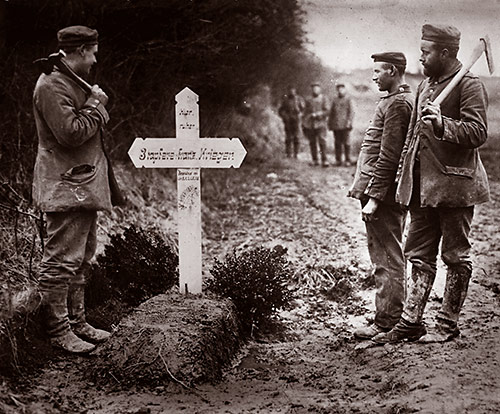
It is the Soldier, not the minister
Who has given us freedom of religion.
It is the Soldier, not the reporter
Who has given us freedom of the press.
It is the Soldier, not the poet
Who has given us freedom of speech.
It is the Soldier, not the campus organizer
Who has given us freedom to protest.
It is the Soldier, not the lawyer
Who has given us the right to a fair trial.
It is the Soldier, not the politician
Who has given us the right to vote.
It is the Soldier who salutes the flag,
Who serves beneath the flag,
And whose coffin is draped by the flag,
Who allows the protester to burn the flag.
-Charles M. Province
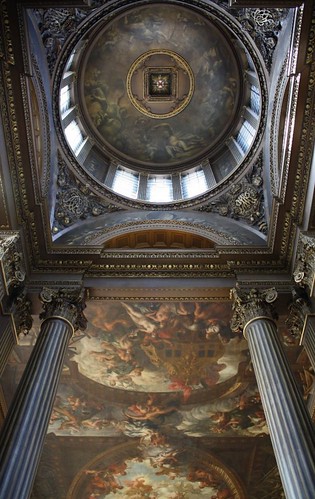
Come, come ye sons of art, come, come away.
Come, come ye sons of art, come, come away.
Tune all your voices and instruments play,
To celebrate, to celebrate this triumphant day.
Tune all your voices and instruments play,
To celebrate, to celebrate this triumphant day.
Praying for the dead, especially for those we have known, is a requirement of Christian charity. Our own prayers and sacrifices can be offered up to relieve their suffering.
Please try and attend the High Mass in order to pray for the relief of the souls in Purgatory.


Without betraying any astonishment, the Queen thanked them for their good news, saying that nothing could be more welcome to her, since she longed for an end to her miseries, and had been prepared for death ever since she had been sent as a prisoner to England. However, she begged the envoys to give her a little time in which to make herself ready, make her will, and place her affairs in order. It was within their power and discretion to grant these requests. The Count of Shrewsbury replied rudely:
'No, no, Madam you must die, you must die! Be ready between seven and eight in the morning. It cannot be delayed a moment beyond that time.' "
Mary spent the rest of the day and the early hours of the next morning writing farewell letters to friends and relatives, saying goodbye to her ladies-in-waiting, and praying. We rejoin de Bourdeille's account as Mary enters the room designated for her execution and is denied access to her priest:
"The scaffold had been erected in the middle of a large room. It measured twelve feet along each side and two feet in height, and was covered by a coarse cloth of linen.
The Queen entered the room full of grace and majesty, just as if she were coming to a ball. There was no change on her features as she entered. In Captivity
Drawing up before the scaffold, she summoned her major-domo and said to him:
'Please help me mount this. This is the last request I shall make of you.'
Then she repeated to him all that she had said to him in her room about what he should tell her son. Standing on the scaffold, she asked for her almoner, (chaplain) begging the officers present to allow him to come. But this was refused point-blank. The Count of Kent told her that he pitied her greatly to see her thus the victim of the superstition of past ages, advising her to carry the cross of Christ in her heart rather than in her hand. To this she replied that it would be difficult to hold a thing so lovely in her hand and not feel it thrill the heart, and that what became every Christian in the hour of death was to bear with him the true Symbol of Redemption."
Standing on the scaffold, Mary angrily rejects her captors' offer of a Protestant minister to give her comfort. She kneels while she begs that Queen Elizabeth spare her ladies-in-waiting and prays for the conversion of the Isle of Britain and Scotland to the Catholic Church:
"When this was over, she summoned her women to help her remove her black veil, her head-dress, and other ornaments. When the executioner attempted to do this, she cried out: 'Nay, my good man, touch me not!' But she could not prevent him from touching her, for when her dress was lowered as far as her waist; the scoundrel caught her roughly by the arm and pulled off her doublet. Her skirt was cut so low that her neck and throat, whiter than alabaster, were revealed. She concealed these as well as she could, saying that she was not used to disrobing in public, especially before so large an assemblage. There were about four or five hundred people present. The executioner fell to his knees before her and implored her forgiveness. The Queen told him that she willingly forgave him and alI who were responsible for her death, as freely as she hoped her sins would be forgiven by God. Turning to the woman, to whom she had given her handkerchief, she asked for it. She wore a golden crucifix, made out of the wood of the true cross, with a picture of Our Lord on it. She was about to give this to one of her women, but the executioner forbade it, even though Her Majesty had promised that the woman would give him thrice its value in money. After kissing her women once more, she bade them go, with her blessing, as she made the sign of the cross over them. One of them was unable to keep from crying, so that the Queen had to impose silence upon her by saying she had promised that nothing of the kind would interfere with the business in hand. They were to stand back quietly, pray to God for her soul, and bear truthful testimony that she had died in the bosom of the Holy Catholic religion.
One of the women then tied the handkerchief over her eyes. The Queen quickly, and with great courage, knelt dawn, showing no signs of faltering. So great was her bravery that all present were moved, and there were few among them that could refrain from tears. In their hearts they condemned themselves far the injustice that was being done. Execution
The executioner, or rather the minister of Satan, strove to kill not only her body but also her soul, and kept interrupting her prayers. The Queen repeated in Latin the Psalm beginning In te, Damine, speravi; nan canfundar in aeternum. When she was through she laid her head on the block, and as she repeated the prayer, the executioner struck her a great blow upon the neck, which was not, however, entirely severed. Then he struck twice more, since it was obvious that he wished to make the victim's martyrdom all the more severe. It was not so much the suffering, but the cause, that made the martyr.
The executioner then picked up the severed head and, showing it to those present, cried out: 'God save Queen Elizabeth! May all the enemies of the true Evangel thus perish!'
Saying this, he stripped off the dead Queen's head-dress, in order to show her hair, which was now white, and which she had been afraid to show to everyone when she was still alive, or to have properly dressed, as she did when her hair was fair and light.
It was not old age that had turned it white, for she was only thirty-five when this took place, and scarcely forty when she met her death, but the troubles, misfortunes, and sorrows which she had suffered, especially in her prison."

Lay Supremacy:
Reform of the canon law of England from Henry VIII to
Elizabeth I (1529-1571)
Lay Supremacy
From the very outset the reform of the canon law was driven first and foremost
by the constitutional necessity inherent in Henry VIH s claim to the
title of headship in relation to the Church of England. In the preface to his
edition of the Reformatio, John Foxe briefly recounts the tortuous history of
efforts to constitute the Royal Commission which eventually drafted the text
of the revised code presented to Parliament by Thomas Cranmer in 1553.
The earliest suggestion for such a committee originated with the clergy in
Convocation more than twenty years earlier in the midst of political manoeuvres
surrounding Henry's quest for a divorce from Queen Catherine—
"the King's great matter." In 1529 the first in a series of statutes was passed
by Parliament denouncing papal authority as a usurpation of the traditional
jurisdiction of the English ecclesiastical courts, and reasserting the doctrine
of the late-fourteenth century Statutes of Praemunire." Clearly recognizing
the anti-papal writing on the wall, the clergy in Convocation initiated a preemptive
attempt at a systematic overhaul of the canon law four years before
the break with Rome was formally sealed.' The canon law together with
its complex apparatus of courts, procedures, and precedents was so closely
bound up with papal authority that the flexing of royal claims to supreme
ecclesiastical jurisdiction provided an irresistible impetus to constitutional
and legal reform.
On 28 April 1532, in the Answer of the Ordinaries,' the English hierarchy
defended for the last time their constitutional status to conduct their affairs
independently of the civil power. A fortnight later on 16 May, the bishops
voted a formal Act of Submission' which they presented to Henry. In their
submission they promised not to make or promulgate any new ecclesiasticallaws without the license and assent ofthe Sovereign, thus eflFectively abjuring
the papal supremacy. The bishops also offered the entire corpus of the canon
law for royal evaluation by a committee of Parliament. The 'Act of Submission
ofthe Clergy' contains the first reference to a Commission of thirty-two
members charged with the reform of the canon law of England, although
twenty years were to elapse before concrete action was taken to this end (note: the letter "r" often appears as "t"):
So that finally whichsoever ofthe said constitutions, ordinances ot canons ptovincial ot synodal shall be thought and detetmined by yout grace, and by the most patt ofthe said thitty-two persons, not to stand with God's laws, and the laws ofthe tealm, the same to be abtogated and taken away by yout gtace, and the cletgy. And such of them as shall be seen by yout gtace, and by the most patt of the said thitty-two persons to stand with God's laws, and the laws of yout tealm, to stand in full strength and powet, yout grace's most toyal assent and authority once obtained fully given to the same."
In rapid succession Archbishop Warham died (August 1532); Cranmer
was appointed his successor to the see of Canterbury; Henry married Anne
Boleyn (25 January 1533); Henry's marriage to Catherine of Aragon was pronounced
invalid (23 May 1533); Anne was crowned Queen (1 June 1533);
and Henry was excommunicated by Clement VII on 11 July 1533.''' The
thread of hierarchy which linked England through the papacy to the sacramentally
interconnected framework of Christendom was cut. Confirming
the new constitutional reality of royal ecclesiastical supremacy, the 'Act in
Restraint of Appeals' passed by Parliament in 1533 declares England to be an
'empire,' Henry's crown 'imperial,' and dissolves all juridical ties to the see of
Rome on the ground that the English Church is 'sufficient and meet of itself,
without the intermeddling of any exterior person or persons.''
 |


