The icon we are going to see is the icon of Our Lady of Kazan.
It is the icon which was kept by Pope John Paul II in his own apartment for 11 years, from 1993 to 2004. I personally saw it there, when don Stanislaw Dziwisz, the Pope’s personal secretary, now Cardinal Dziwisz of Cracow, invited me once up to the papal apartment to see it.
This revered Russian icon, which depicts Mary holding the child Jesus, was first discovered under mysterious circumstances by a young Russian girl named Matrona in 1579.
Very early on, miraculous healings were attributed to it, and this prompted the Czar to call for it to be brought to Moscow. Over the following centuries, whenever Russia was in grave military danger, including against Napoleon, the Russian Czar and people
would pray before the icon, and on each occasion, the nation was preserved from defeat. And for this reason, the icon came to be popularly known as “the Protection of Russia.”
In 1918, during the Bolshevik revolution, when religious objects were being destroyed and churches turned into latrines, the icon was also in danger, but it escaped. It was spirited out of the country and into the hands of an art dealer in Warsaw. Through many twists and turns, the icon found its way, it is believed (the story still needs to be thoroughly reconstructed) from Warsaw to London, from London to New York, and from New York to… Fatima, Portugal.
Yes, for many years, this most famous Marian icon of Russia was in Portugal, in a special chapel built especially for it next to the site of the apparitions of the Madonna to the three children of Fatima in 1917.
During the 1970s and 1980s, many Russians began to hear that it was kept there, and journeyed to Fatima to venerate it.
Then, in 1991, on Christmas Day, Mikhail Gorbachev signed the document dissolving the Soviet Union. Open religious persecution in Russia was over. The icon could return to Russia without danger of being destroyed.
Immediately, Pope John Paul II went into action. He wrote to Fatima, asking that the icon of Our Lady of Kazan be brought to him in Rome. (I have seen copies of the letter.)
The icon left Fatima and came to Rome in 1993. It was placed on the wall of the Pope’s own private study, and I have been told that the Pope prayed before it almost every day, sometimes for half an hour.
For the next 11 years, John Paul sought a way to carry the icon himself back to Russia — to return Mary, “the Protection of Russia,” back to Russia.
But there was resistance in Russia to inviting the Pope to visit the country. And the invitation never came.
Finally, in 2004, knowing that he would die soon, and would never be able to bring the icon back to Russia himself, Pope John Paul decided simply to send the icon back. “Mary wants to return to Russia,” Dan Stanislaw once said to me.
And so, in August 2004, John Paul sent a special delegation to Moscow, and the icon was handed over to Patriarch Alexi II, and returned to Russia on August 28 of that year.
The question then arose of what would be the fate of the icon, now that it was back in Russia.
The decision was made to return it to Kazan, and to build a pilgrimage center there. In this way, the “protection of Russia” could be venerated by the Russian Orthodox, but also by Kazan’s Muslims, who have a great veneration for the icon and for Mary, and also by Catholics and others, making Kazan into a type of symbolic “city of peace” in a world where religious warfare, despite centuries of secularization, seems to loom darkly over our future.
And the planning for this pilgrimage center was entrusted to my two friends, Maxim Gritschkin and Dmitri Khafizov. (Khafizov in 2001 wrote articles for Inside the Vatican about how much the people of Kazan longed for the return of “their” icon, articles I was told were read by the Pope and moved him deeply, perhaps influencing his decision to return the icon to Kazan.)
“Robert!” Dmitri shouted, when we drove up to the sanctuary gate with Father Diogenes. “Welcome!” And he enfolded me in a Russian-style bear-hug.
We entered through the sanctuary gates, and made our way toward the wide stairway which leads up to the second floor where the icon is kept.
I remembered coming here in the summer of 2000 and climbing these same steps, and on the second floor a choir of Russian children had been gathered to sing for us. Their voices had seemed to bring human song to the portals of heaven, and that song had moved me deeply, and was a factor in my decision to try to work for a brighter future for such children, and now I was back again in this same place, experiencing what Walker Percy calls “repetition” — the memory of “then” and the experience of “now” in one place, mirroring and so intensifying one’s experience of reality.
The icon is in the far corner of the upper room, behind protective glass. There are two steps in front of it, and a stand of candles.
Next to the icon is another case which contains the tiny piece of the robe of the Virgin Mary, and other relics, brought last year from Rome by Immacolata. Click for article on Immacolata’s gift.
The moment comes to venerate the icon.
What does veneration mean? Why venerate a painting? Is it something superstitious, or silly?
The iconoclasts of all ages have thought so, and they have destroyed the images and icons which they feel distract men and women from the awesome transcendence of God. This has always been a tendency within Christianity (remember not only the Iconoclasts, but also those Protestant groups which have shattered stained glass windows and religious statues in their righteous zeal for the greatness of God), within Judaism, and especially within Islam, where it reaches its most radical form — no images whatsoever, only geometric patterns.
But an icon is not a painting. No painter paints an icon. The painter disappears, and the Holy Spirit does the painting, and what is painted is not an image, but a window, from this time into that one, from time, into eternity. It is something other than what the iconoclasts imagine, and that is why they can be forgiven, for they know not what they do.
As one draws closer to the icon, one feels a certain warmth, as if from a holy fire.
It isn’t just the candles, although the candles, too, are warm, and bright. How many prayers are contained in the wax of those candles, which are being oxidized by the flame from the wick, which flickers upward toward heaven?
We are never worthy to pray, to ask for the deep things we long for. We long for them, and wish for them, and hope for them. And these are the gifts that prayer brings, even before it rises to God. For it elicits from our own heart the clarity of what our deepest longings are: good things for our families, peace for our friends, prosperity for all, patience for ourselves in the face of many difficulties, joy even in sorrow.
It would be a poor world in which prayers no longer were prayed.
And now I am directly in front of “the Protection of Russia,” the icon of Our Lady of Kazan.
Silence.
Friday, November 20, 2009
Our Lady of Fatima, Our Lady of Kazan


Thursday, November 19, 2009
Lighten Up
Laudate Dominum, Omnes Gentes
Praise and worship have come to be words easily infected by the liberals amongst us, for they tell us with much arm-waving and bongo-banging that the lofty prayers of old, offered with dignity and royal majesty, were unpleasing to Our Lord. "He would want that money and thought to go to the poor."
But Our Lord also reprimanded the traitor bishop Judas when at the house of St. Martha:
"Then one of his disciples, Judas Iscariot, he that was about to betray him, said: 5 Why was not this ointment sold for three hundred pence and given to the poor? 6 Now he said this not because he cared for the poor; but because he was a thief and, having the purse, carried the things that were put therein. 7 Jesus therefore said: Let her alone, that she may keep it against the day of my burial. 8 For the poor you have always with you: but me you have not always."
So the verdict of Our Lord is, of course, to love and serve the poor as we would love and serve Christ Himself, but when confronted with His Real Presence, we should venerate and spare no expense for Him. "For the poor you have always with you."
Indeed, the liberal notions of "praise" and "worship" deal not with the honoring of God, but with the honoring of humanity. There is nothing so humbly full of praise than a simple chanted Sequence, nothing so humbly offered as the rising clouds of incense about the altar of God. Our Lord would be affronted by any showing of disrespect - look no further than his reaction to the irreverence and worship of humanity He found in the Temple in Jerusalem. He reacted to this unbridled lust for money out of love for two things: love for the poor and love for Divinity. For both were being disrespected.
Disrespect was not tolerated by Our Lord. Indeed, it was the only thing in the Gospels to which he violently reacted. The liberal mindset ends here: "Jesus punished excess." The truly Catholic mindset continues forward to the statement, "Jesus punished excess, but there can be no notion of 'excess' when God is the recipient." The majesty of God is so great that gold is as dirt before Him. This is no reason whatsoever to literally place Him, present in the Holy Eucharist, into clay pots and wooden chalices. Of course Jesus didn't have anything better at the Last Supper! For the Jews and Gentiles did not grasp the notion that God was among them. If they had, rest assured, Our Lord would have been draped in the purple garb of royalty in honest adoration as opposed to the mockery of His Passion when the soldiers so disdainfully declared, "Behold the King of the Jews!"
"Great is the Lord, and worthy to be praised." Yes, He is great indeed, and worthy to receive our praise. No expense should be spared, for at the Mass God comes into our presence, descending "meekly, lowly at the words of the priest." What a Divine mandate! That we should be so honored that the God of all descends onto our tables of stone and timber, and takes His dwelling in vessels of silver and gold!
The goal of beauty and of musical splendor is to render to God the glory due unto His Name, not to deprive the poor or to give power and riches to the Church. No, praise and worship constitute the humble offerings of the best things we have on this Earth which, when compared to the inestimable majesty of Heaven, seems as mere dust. Remember this the next time your priest brings Our Lord down to us into a clay pot. Remember this the next time you see your "pastoral administrator" self-communicating without so much as a bow, in deference to God's omnipotence. Remember this the next time you see altar girls whose albs are so short as to reveal the latest fad underneath. Remember this the next time a guitar is pulled out to render glory unto God.
We are unworthy enough as it is, so why compound our state even more by lowering God to be "just another parishioner?" He is God, and could wish all existence out of being in the time it takes to read just one more word. Do not be a Judas, and attempt to remove from Our Lord the laud which all people must render to Him. "Laudate Dominum, Omnes Gentes."

"Let God Arise"
Wednesday, November 18, 2009
A "Put Up or Shut Up Moment" CCHD Boycott
To get a coupon to toss into the collection basket, click on the link:
http://www.reformcchdnow.com/coupon/coupon.pdf
Read this link too:
www.pewsitter.com/view_news_id_26176.php
It Makes One Tremble
- "The Immaculate Conception - anyone who thinks it's true is sick and perverted. I mean, really, it's disgusting to even think of something like that happening."
(Does this really require any comment on my part?) - "With the Father and the Son She is worshiped and glorified." For the final time: the Church has been around for 2,000 years. We've been around for less than a century, most of us being around for less than half of a century. So why do we, in our sheer arrogance, think that our opinions (and that's just what they'll remain) have an affect on the Church? She is timeless. To refer to a person of the Trinity based more on the pantheistic faiths of the Greeks and Romans than on our own Christian Tradition is to commit a most grievous error. Sorry, but it is. Catholics believe that St. Jerome was moved by God Himself to translate the original texts of the Bible into Latin for liturgical and devotional purposes. Yeah, that means there was some kind of "Divine Revelation" going on there. In his translating, he used without deviation the word "spiritus" to describe the Person of the Holy Ghost. "Spiritus" is a masculine noun, and St. Jerome made specific use of that, with MANY nouns and adjectives relating to this "spiritus" using the same masculine declension. In the words of Sr. Joan, "it is what it is."
- "And that's when the Church said it was okay to use contraceptives. I mean, if two people really love each other, what's the big deal?" The Church has NEVER said it is alright to use contraceptives. If you were led to believe such a thing, your instructor, whomever he or she might be, is in grave error concerning the Church's teaching. For anyone suffering from he delusions of indifference like this young individual was, go to the Vatican's website and read Humanae Vitae. Seriously. Do it.
- "It really doesn't matter if there's a religious Truth or not. I mean, we all worship the same God or gods, so we're all going to heaven." It does matter. The Church professes that if you are given the religious Truth, i.e. Jesus Christ and His Church, and that you knowingly and willingly reject it, you are, indeed, putting your immortal soul at a huge risk. This young lady was doing just that.
Do not let yourself become apathetic. Act on your convictions. Don't be ashamed of your Faith! Spread it gently and with compassion, for we all know that the enemy has no way to defend against lovingly-given Truth. I am not saying these things out of some distorted sense of arrogance and pride, but rather, a sense of Faith, for this Faith is what is our defense against error. Knowledge is of God, and error is of Satan. Pick your side, for we're at war.
Tuesday, November 17, 2009
St. Anne Church Financial Statement

"Collection (sic) were down 21% from that budgeted, with overall revenues down 12%. St. Anne finished the year with a net operating loss of $103,011, which resulted in an outstanding payable to Monroe County Catholic Schools for a portion of the year's school assessment and CMA underage owing to the Diocese of Rochester."
So, evidently the philosophy of voting with one's wallet is working. There are so many things one could throw back into the face of Sr. Sobala, things which she herself said, but for the sake of Christian charity, I will not. (The comment box is conveniently located below this post.)
But wait! There's more!
"Several changes were implemented to turn around the Church's financial condition, which include lower personnel costs, a lowering of the school assessment costs, restructuring of the Canandaigua National Bank mortgage, and the hiring of the Cunneen Group to help increase weekly collections."
"Several changed were implemented to turn around the Church's financial condition." The Church? No, I think you mean "the church," as in "little-c" church, as in "not the Universal Church."
"Lowering personnel costs." I have a plan to reduce them even further - one administrator, one priest, no subversive nuns who have nothing but contempt for Truth and Tradition.
"A lowering of school assessment costs." Ah, yes, because the people of St. Anne would rather have their money go to the "Sr. Joan alb fund" as opposed to Catholic Schools.
"The hiring of the Cunneen Group to help increase weekly collections." The Cunneen Group . . . In my personal opinion (which is a proven fact), orthodoxy pays more than "offertory enhancement." Is it really so hard to grasp that people left because they were a. told to, b. made to feel unwelcome and unwanted, c. ostracizied by the new administration, and d. because the music and liturgical prowess of the parish have died? The majority of the altar servers, according to a reader, are irreverent altar girls who have no sense of decorum or grace. The Saturday evening Mass now has NO scheduled altar servers, boys or girls. It speaks volumes that even the little children whom the Lord calls unto Him have fled for greener pastures.


Monday, November 16, 2009
"Let God Arise, and Let His Enemies Be Scattered"

We will be commencing on our next leg of "Everything English Month" this afternoon. The featured music will be by the famous English/German composer Handel, whose grasp of sacred choral music, be it Protestant or Catholic, was absolutely majestic.
And, of course, we mustn't forget that we listen to Handel's Messiah every year at Christmas time. We'll explore some lesser-known parts of this famous work.
Also included will be portions from his coronation anthems and selections from his "Music for the Chapel Royal." I hope to have these up by around three o'clock today - if they're not up, I apologize.
For The Sake of Inclusivity

Friday, November 13, 2009
How to Worship Video
From the Crescat blog. I guess the parishioners at Assumption in Fairport have watched this video from what I saw on their video.
The Martyrdom of St. John Fisher

His lips were moving in prayer, as they carried him to Tower Hill. And when they reached the scaffold, the rough men of his escort offered to help him up the ladder. But he smiled at them: "Nay, masters, now let me alone, ye shall see me go up to my death well enough myself, without help." And forthwith he began to climb, almost nimbly. As he reached the top the sun appeared from behind the clouds, and its light shone upon his face. He was heard to murmur some words from Psalm 33: Accedite ad eum, et illuminamimi, et facies vestræ non confundentur. The masked headsman knelt - as the custom was - to ask his pardon. And again the cardinal's manliness dictated every word of his answer: "I forgive thee with all my heart, and I trust on Our Lord Thou shalt see me die even lustily." Then they stripped him of his gown and furred tippet, and he stood in his doublet and hose before the crowd which had gathered to see his death. A gasp of pity went up at the sight of his "long, lean, slender body, nothing in manner but skin and bones ... the flesh clean wasted away, and a very image of death, and as one might say, death in a man's shape and using a man's voice." He was offered a final chance to save his life by acknowledging the royal supremacy, but the saint turned to the crowd, and from the front of the scaffold, he spoke these words:
"Christian people, I am come hither to die for the faith of Christ's Catholic Church, and I thank God hitherto my courage hath served me well thereto, so that yet hitherto I have not feared death; wherefore I desire you help me and assist me with your prayers, that at the very point and instant of my death's stroke, and in the very moment of my death, I then faint not in any point of the Catholic Faith for fear; and I pray God save the king and the realm, and hold His holy hand over it, and send the king a good counsel."
The power and resonance of his voice, the courage of his spirit triumphing over the obvious weakness of his body, amazed them all, and a murmur of admiration was still rustling the crowd when they saw him go down on his knees and begin to pray. They stood in awed silence while he said the Te Deum in praise of God, and the Psalm [70] In Thee O Lord have I put my trust, the humble request for strength beyond his own. Then he signed to the executioner to bind his eyes. For a moment more he prayed, hands and heart raised to heaven. Then he lay down and put his wasted neck upon the low block. The executioner, who had been standing back, took one quick step forward, raised his axe and with a single blow cut off his head. So copious a stream of blood poured from the neck that those present wondered how it could have come from so thin and wasted a frame. There was certainly divine irony in the fact that 22 June, the date of the execution, was the Feast of St. Alban, the first Martyr for the Faith in Britain. If the king had realized this he would certainly have arranged for the execution of Cardinal Fisher to take place on another day.
Tridentine Latin Mass at Holy Spirit Church
Thursday, November 12, 2009
Link to British Catholic Blogs
http://britcat.blogspot.com/
Here is a link to a Monarchy blog.
http://themonarchist.blogspot.com/
TTFN!!
Just, and Firm of Purpose Are We
Why, none other than the Romanov family, the line of czars that ruled Russia for three hundred years. While many people know that the Russian royal family was deposed and executed in the Russian or "Bolshevik" Revolution, few know that the Czar, his wife, their five children, and four household servants were canonized in the Russian Orthodox Church which, in a sense, makes them "half-saints" of the Catholic Church. We may not have been the actual "canonizers," but I think we in the Latin Church can still appreciate the trials they went through and which contributed to their being named "Passion Bearers" for Christ in recent years.

Here is a summary of the last few days of the Romanov family:
The Romanovs, as history has been able to remove the spin of Soviet Russia, have been put in a different light. Nicholas did not delight in the sufferings of his people - he wished to join them in suffering. They lived in opulence - but they also gave much to their country and much to God. The royal family would often meet trains of troops going to the front in WWI, and hand each soldier, personally, a prayer card."Gradually these guards were humanised by contact with their prisoners. They were astonished at their simplicity, attracted by their gentleness, subdued by their serene dignity, and soon found themselves dominated by those whom they thought they held in their power. The drunken Avdiev found himself disarmed by such greatness of soul; he grew conscious of his own infamy. The early ferocity of these men was succeeded by profound piety."
When this would happen, the inhuman Bolsheviks would replace the guards who had been so touched with crueller and more animalistic ones.
Seldom being allowed to go to church, they nevertheless nourished their souls with home prayers and greatly rejoiced at every opportunity to receive the Divine sacraments. Three days before their martyrdom, in the very house in which they were imprisoned, there took place the last church service of their suffering lives. As the officiating priest, Fr. John Storozhev, related: "'It appeared to me that the Emperor, and all his daughters, too, were very tired. During such a service it is customary to read a prayer for the deceased. For some reason, the Deacon began to sing it, and I joined him... As soon as we started to sing, we heard the Imperial Family behind us drop to their knees' (as is done during funeral services)... Thus they prepared themselves, without suspecting it, for their own death - in accepting the funeral viaticum. Contrary to their custom none of the family sang during the service, and upon leaving the house the clergymen expressed the opinion that they 'appeared different' - as if something had happened to them."
The Tsaritsa (wife of Nicholas II, the czar) used to say:
"We are one, and this, alas, is so rare today. We are tightly united together... a small, tightly knit family..."
Inseparable in life, they were now to remain unseparated in death.
After midnight on July 4/17, 1918, the entire family, with their doctor and two faithful servants, was brought to the basement of the house of their confinement under the pretext of moving them once again. There they were brutally and mercilessly murdered, the children as well as the adults, under the cover of darkness - for "men loved the darkness rather than light, because their deeds were evil" (John 3.19). The Tsar was shot as he stood forward to defend his family. Tsaritsa Alexandra was able to make the sign of the Cross before she, too, fell. The first bullets did not bring death to the youngest ones, and they were savagely clubbed, bayoneted and shot at point-blank range.
Those killed were: the Tsar (born 1868), the Tsaritsa (1872), Olga (both 1895), Tatiana (1897), Maria (born 1899), Anastasia (born 1901), Alexis (born 1904), the Tsar's physician Eugene Botkin, the Tsaritsa's chamber-maid Anna Demidova, the cook Kharitonov and the servant Trupp. The sailor Clement Nagorny, who had looked after the Tsarevich since early childhood, and Sergius Sednev, the servant to the Grand Duchesses, both of whom had defended the Royal Family from robbery and insults in Ekaterinburg, were taken away to prison and shot there. Those who were refused permission to stay with the Royal Family at Ekaterinburg, and who were also shot in prison were General Elias Tatishchev and Prince Basil Dolgorukov. The maid-of-honour, Countess Anastasia Hendrikova, and the court teacher, Ekaterina Schneider, were taken to Perm and shot there.

There are accounts of Alexei, the son of the Czar and a hemophiliac, fighting from his sick bed with a guard who attempted to steal his Chotki, an Orthodox version of the Rosary.
If only all royalty would have had such courage and love for their faith!

New Header - Feedback?
Comments? Critiques? Suggestions?
Please let me know. Send an email to cleansingfire@live.com or just leave a comment below.
Wednesday, November 11, 2009
Veterans Day - Armistice Day
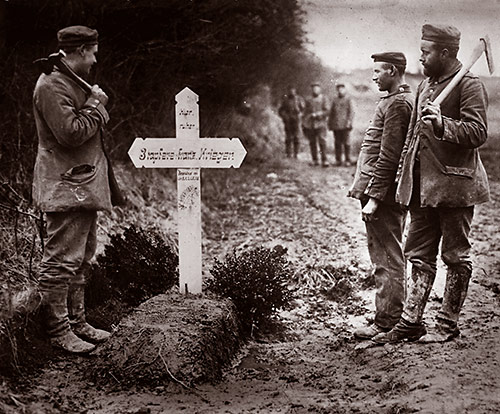
Few people actually understand why Veterans' Day is celebrated on November the Eleventh. On November 11, 1918, at 11 AM, the First World War effectively ended with the signing of an Armistice agreement between the Central Powers (Germany, Austria-Hungary, Ottoman Empire) and the Allied Powers (Great Britain, France, Italy, United States, Japan). In honor of the millions who have died unsung deaths is this poem dedicated:
It is the Soldier, not the minister
Who has given us freedom of religion.
It is the Soldier, not the reporter
Who has given us freedom of the press.
It is the Soldier, not the poet
Who has given us freedom of speech.
It is the Soldier, not the campus organizer
Who has given us freedom to protest.
It is the Soldier, not the lawyer
Who has given us the right to a fair trial.
It is the Soldier, not the politician
Who has given us the right to vote.
It is the Soldier who salutes the flag,
Who serves beneath the flag,
And whose coffin is draped by the flag,
Who allows the protester to burn the flag.
-Charles M. Province
"Come, Come Ye Sons of Art Away!"
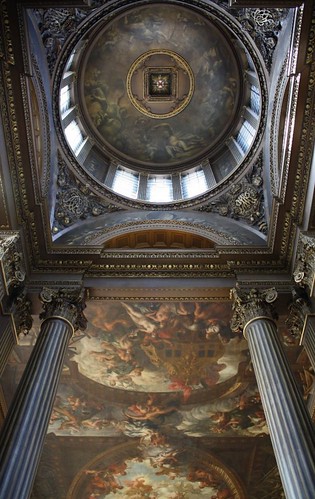
After eleven days of reveling in renaissance polyphony, I should like to inaugurate the second part of "Everything English Month." This next set readings and musical selections come from the years after the English Civil War, anti-Catholic legislation passed by Puritans, and the "Glorious Restoration" of the English monarchy in 1660. We pick up our exploration in the era now typically called "Baroque."
The first dose of Anglo-Catholic/Roman-Catholic Baroqueness will be a selection of pieces from the illustrious composer Henry Purcell, who lived from 1659 until 1695, preceding Handel, whose work we shall hear later this month. Enjoy!
One piece featured in the music bar to the right is "Come Ye Sons of Art Away," and adroitly describes the sentiment of Rochester Catholics when the countdown reaches 0 . Even though Purcell himself wasn't a Catholic, I think we can all agree he got music spot on, if not doctrine. The lyrics are:
Come, come ye sons of art, come, come away.
Come, come ye sons of art, come, come away.
Tune all your voices and instruments play,
To celebrate, to celebrate this triumphant day.
Tune all your voices and instruments play,
To celebrate, to celebrate this triumphant day.
Tuesday, November 10, 2009
SLAP - Survivors of Liturgical Abuse in Parishes
http://www.facebook.com/group.php?gid=163446277798&ref=nf
From Father Z's blog, here is a parody on "Gather Us In"
Here in this place, our comfortable parish,
All of the statues carried away,
See in each face a vacuous visage,
Brought here by guilt or by R.C.I.A.
Gather us in, by Beemer or Hummer,
Gather us in, so we can feel good,
Come to us now in this barren Zen temple,
With only a shrub and an altar of wood.
We are the young, our morals a mystery,
We are the old, who couldn’t care less,
We have been warned throughout all of history,
But we enjoy this liturgical mess.
Gather us in, our radical pastor,
Gather us in, our unveiled nun,
Call to us now, with guitars and bongos,
Hang up your cellphones and join in the fun!
Next High Mass @ St. Stanislaus
The choir will sing Victoria's "O Magnum Mysterium" for the ordinary parts of the Mass. The schola will sing the Gregorian propers.
The choir motets will be "Miserere" by Antonio Lotti and Claudio Monteverdi's 6-part motet "Domine, ne in furore".
Here are previews of both motets.
and the Monteverdi --
By tradition, the Church dedicates each month of the year to a certain devotion. In November, it is the Holy Souls in Purgatory, those faithful Christians who have died and gone before us but who still must atone for their sins. The time they spend in Purgatory cleanses them so that they may enter Heaven free from all effects of sin.
Praying for the dead, especially for those we have known, is a requirement of Christian charity. Our own prayers and sacrifices can be offered up to relieve their suffering.
Please try and attend the High Mass in order to pray for the relief of the souls in Purgatory.
The Trial of St. Thomas More
For The Sake of Solidarity

I received an email from one of my friends who clicks "Forward to everyone" at least five times per day. Usually, that's pretty annoying. However, this email was somewhat thought-provoking. In it, the original author noted how in the Oklahoma City bombing of 1995, Timothy McVeigh, "a Roman Catholic from Lockport, New York," was responsible for a massive loss of life. The message goes on to ask that all people, for the sake of solidarity, not hold Muslims culpable for the heinous acts of the one individual who went on a murderous rampage at Fort Hood. I agree with that, however I think it's interesting how the argument works: A man who happens to be Catholic blows up a building because of his contempt for the government compared to a man who yells Allahu Akbar before killing American soldiers because, in his opinion, "Muslims need to stand up and wage jihad against America." I have nothing but compassion for the worldwide Muslim community who may be targeted by ignorant and closed-minded individuals, but I think we need to stop dancing around the facts:
A Muslim committed an act of terrorism because his interpretation of his faith led him to do so.
One need not say that this interpretation of the Qur'an was flawed - that's too obvious for words. I sincerely hope that, for the true sake of solidarity, all who read this blog offer a few moments of prayer for the perpetrator, those of his faith who will now suffer unduly, and those among us who have nothing but contempt for Islam. The Catholic Church holds that all faith has some measure of Truth within it, but that some faiths contain more Truth than others. As Catholics we must, as I have said time after time, hate the sin but love the sinner. While Islam has tended to be a religion more of subjugation of others, not subjugation to God, many Muslims have done noble things for the world. Pray for them as we pray for all people: that they may, in time, see the whole Truth of God and His Church. After all, as Our Lord Himself says, we cannot come to the Father but through the Son.
Monday, November 9, 2009
Photo Caption Contest #8

Sunday, November 8, 2009
Fishers of Men Videos
Part One
Part Two
Saturday, November 7, 2009
Flu Concerns at OLV
The Death of Mary Stuart, Queen of Scots
"On February 7, 1587, the representatives of the English Queen, reached the Castle of Fotheringay, where the Queen of Scotland was confined at that time, between two and three o'clock in the afternoon. In the presence of her jailer, Paulet, they read their commission regarding the execution of the prisoner, and said that they would proceed with their task the next morning between seven and eight o'clock. The jailer was then ordered to have everything in readiness.
Without betraying any astonishment, the Queen thanked them for their good news, saying that nothing could be more welcome to her, since she longed for an end to her miseries, and had been prepared for death ever since she had been sent as a prisoner to England. However, she begged the envoys to give her a little time in which to make herself ready, make her will, and place her affairs in order. It was within their power and discretion to grant these requests. The Count of Shrewsbury replied rudely:
'No, no, Madam you must die, you must die! Be ready between seven and eight in the morning. It cannot be delayed a moment beyond that time.' "
Mary spent the rest of the day and the early hours of the next morning writing farewell letters to friends and relatives, saying goodbye to her ladies-in-waiting, and praying. We rejoin de Bourdeille's account as Mary enters the room designated for her execution and is denied access to her priest:
"The scaffold had been erected in the middle of a large room. It measured twelve feet along each side and two feet in height, and was covered by a coarse cloth of linen.
The Queen entered the room full of grace and majesty, just as if she were coming to a ball. There was no change on her features as she entered. In Captivity

Drawing up before the scaffold, she summoned her major-domo and said to him:
'Please help me mount this. This is the last request I shall make of you.'
Then she repeated to him all that she had said to him in her room about what he should tell her son. Standing on the scaffold, she asked for her almoner, (chaplain) begging the officers present to allow him to come. But this was refused point-blank. The Count of Kent told her that he pitied her greatly to see her thus the victim of the superstition of past ages, advising her to carry the cross of Christ in her heart rather than in her hand. To this she replied that it would be difficult to hold a thing so lovely in her hand and not feel it thrill the heart, and that what became every Christian in the hour of death was to bear with him the true Symbol of Redemption."
Standing on the scaffold, Mary angrily rejects her captors' offer of a Protestant minister to give her comfort. She kneels while she begs that Queen Elizabeth spare her ladies-in-waiting and prays for the conversion of the Isle of Britain and Scotland to the Catholic Church:
"When this was over, she summoned her women to help her remove her black veil, her head-dress, and other ornaments. When the executioner attempted to do this, she cried out: 'Nay, my good man, touch me not!' But she could not prevent him from touching her, for when her dress was lowered as far as her waist; the scoundrel caught her roughly by the arm and pulled off her doublet. Her skirt was cut so low that her neck and throat, whiter than alabaster, were revealed. She concealed these as well as she could, saying that she was not used to disrobing in public, especially before so large an assemblage. There were about four or five hundred people present. The executioner fell to his knees before her and implored her forgiveness. The Queen told him that she willingly forgave him and alI who were responsible for her death, as freely as she hoped her sins would be forgiven by God. Turning to the woman, to whom she had given her handkerchief, she asked for it. She wore a golden crucifix, made out of the wood of the true cross, with a picture of Our Lord on it. She was about to give this to one of her women, but the executioner forbade it, even though Her Majesty had promised that the woman would give him thrice its value in money. After kissing her women once more, she bade them go, with her blessing, as she made the sign of the cross over them. One of them was unable to keep from crying, so that the Queen had to impose silence upon her by saying she had promised that nothing of the kind would interfere with the business in hand. They were to stand back quietly, pray to God for her soul, and bear truthful testimony that she had died in the bosom of the Holy Catholic religion.
One of the women then tied the handkerchief over her eyes. The Queen quickly, and with great courage, knelt dawn, showing no signs of faltering. So great was her bravery that all present were moved, and there were few among them that could refrain from tears. In their hearts they condemned themselves far the injustice that was being done. Execution

The executioner, or rather the minister of Satan, strove to kill not only her body but also her soul, and kept interrupting her prayers. The Queen repeated in Latin the Psalm beginning In te, Damine, speravi; nan canfundar in aeternum. When she was through she laid her head on the block, and as she repeated the prayer, the executioner struck her a great blow upon the neck, which was not, however, entirely severed. Then he struck twice more, since it was obvious that he wished to make the victim's martyrdom all the more severe. It was not so much the suffering, but the cause, that made the martyr.
The executioner then picked up the severed head and, showing it to those present, cried out: 'God save Queen Elizabeth! May all the enemies of the true Evangel thus perish!'
Saying this, he stripped off the dead Queen's head-dress, in order to show her hair, which was now white, and which she had been afraid to show to everyone when she was still alive, or to have properly dressed, as she did when her hair was fair and light.
It was not old age that had turned it white, for she was only thirty-five when this took place, and scarcely forty when she met her death, but the troubles, misfortunes, and sorrows which she had suffered, especially in her prison."
Friday, November 6, 2009
Thursday, November 5, 2009
The Tudor Truth and Protestant Perpetrations Part II

Last time we spoke of the Tudor Truth and Protestant Perpetrations, I noted that we would begin next time with "battle lines being drawn." Well, no better way to do this than to show that the current debate about Canon Law and Lay Involvement (which shouldn't be a debate because Rome has spoken) was just as wide-spread in the 16th Century as it is now. Note that back then, this resulted in murder, intrigue small-scale genocide and a general loathing of anything Traditional.
Lay Supremacy:
Reform of the canon law of England from Henry VIII to
Elizabeth I (1529-1571)
Lay Supremacy
From the very outset the reform of the canon law was driven first and foremost
by the constitutional necessity inherent in Henry VIH s claim to the
title of headship in relation to the Church of England. In the preface to his
edition of the Reformatio, John Foxe briefly recounts the tortuous history of
efforts to constitute the Royal Commission which eventually drafted the text
of the revised code presented to Parliament by Thomas Cranmer in 1553.
The earliest suggestion for such a committee originated with the clergy in
Convocation more than twenty years earlier in the midst of political manoeuvres
surrounding Henry's quest for a divorce from Queen Catherine—
"the King's great matter." In 1529 the first in a series of statutes was passed
by Parliament denouncing papal authority as a usurpation of the traditional
jurisdiction of the English ecclesiastical courts, and reasserting the doctrine
of the late-fourteenth century Statutes of Praemunire." Clearly recognizing
the anti-papal writing on the wall, the clergy in Convocation initiated a preemptive
attempt at a systematic overhaul of the canon law four years before
the break with Rome was formally sealed.' The canon law together with
its complex apparatus of courts, procedures, and precedents was so closely
bound up with papal authority that the flexing of royal claims to supreme
ecclesiastical jurisdiction provided an irresistible impetus to constitutional
and legal reform.
On 28 April 1532, in the Answer of the Ordinaries,' the English hierarchy
defended for the last time their constitutional status to conduct their affairs
independently of the civil power. A fortnight later on 16 May, the bishops
voted a formal Act of Submission' which they presented to Henry. In their
submission they promised not to make or promulgate any new ecclesiasticallaws without the license and assent ofthe Sovereign, thus eflFectively abjuring
the papal supremacy. The bishops also offered the entire corpus of the canon
law for royal evaluation by a committee of Parliament. The 'Act of Submission
ofthe Clergy' contains the first reference to a Commission of thirty-two
members charged with the reform of the canon law of England, although
twenty years were to elapse before concrete action was taken to this end (note: the letter "r" often appears as "t"):
So that finally whichsoever ofthe said constitutions, ordinances ot canons ptovincial ot synodal shall be thought and detetmined by yout grace, and by the most patt ofthe said thitty-two persons, not to stand with God's laws, and the laws ofthe tealm, the same to be abtogated and taken away by yout gtace, and the cletgy. And such of them as shall be seen by yout gtace, and by the most patt of the said thitty-two persons to stand with God's laws, and the laws of yout tealm, to stand in full strength and powet, yout grace's most toyal assent and authority once obtained fully given to the same."
In rapid succession Archbishop Warham died (August 1532); Cranmer
was appointed his successor to the see of Canterbury; Henry married Anne
Boleyn (25 January 1533); Henry's marriage to Catherine of Aragon was pronounced
invalid (23 May 1533); Anne was crowned Queen (1 June 1533);
and Henry was excommunicated by Clement VII on 11 July 1533.''' The
thread of hierarchy which linked England through the papacy to the sacramentally
interconnected framework of Christendom was cut. Confirming
the new constitutional reality of royal ecclesiastical supremacy, the 'Act in
Restraint of Appeals' passed by Parliament in 1533 declares England to be an
'empire,' Henry's crown 'imperial,' and dissolves all juridical ties to the see of
Rome on the ground that the English Church is 'sufficient and meet of itself,
without the intermeddling of any exterior person or persons.''
You're not going to believe this

Planned Parenthood is asking Catholics to call Congress and demand taxpayer support for abortion.
The billion-dollar organization already receives over $300 million in taxpayer money, and stands to strike it rich if nothing is changed in the current health care legislation.
So this week the nation’s biggest abortion provider sent out an urgent message to counter the growing opposition by Catholics to taxpayer-funded abortion contained in the current health care bills.
The Catholic Bishops sprung into action late last week, announcing their strong opposition to the current health care legislation because the bills include taxpayer support for abortion and fail to provide a conscience clause for doctors.
The Bishops have asked all Catholics to petition Congress to remove any support for abortion from the health care bill.
So Planned Parenthood is attacking the Catholic Bishops and calling their actions “dangerous.”
Here’s what Planned Parenthood’s President Cecile Richards said in a message this week to her supporters: “If you’re Catholic and you disagree with the bishops, please let your legislators know when you send your message. Your voice as a pro-choice Catholic needs to be heard NOW.”
What?!!
How can you be a Catholic and support abortion, the killing of millions of our brothers and sisters?
The phones are ringing in the halls of Congress. Will activists claiming to be Catholic and pro-abortion be the only ones calling?
TAKE ACTION NOW
In the next 48 hours, House Speaker Nancy Pelosi is expected to try and ram through a vote to prevent any amendment from being offered to the current legislation. The vote on a “closed rule” would slam the door on any effort to offer a pro-life amendment to the healthcare bill.
Catholics, pro-life advocates and all people of faith need to move quickly!
Call 202-224-3121. Tell your Member of Congress to VOTE NO on the “closed rule” for H.R. 3962. Tell them to allow a vote on the Stupak Amendment.
If you do not know your representative, look him or her up here: http://www.congress.org/congressorg/directory/congdir.tt - With this directory you can lookup your Representative's local office phone number. Representatives pay more attention to calls made to their local office.
A bipartisan group led by Rep. Joe Pitts (R-PA) and Rep. Bart Stupak (D-MI) want to amend the healthcare bill by adding pro-life protections. This is what the Catholic bishops have asked for, and what an overwhelming majority of Americans want.
Here’s what the Associated Press reported Oct. 23: “Such an amendment would be almost certain to prevail, since it likely would attract the votes of most Republicans as well as some Democrats. So Democratic leaders won’t let Stupak offer it.”
If you have already called or written your Member of Congress, it is urgent that you contact them again right now.
So much is on the line. The Bishops know it. Planned Parenthood and Nancy Pelosi know it.
Send this email to all your friends and family. And call your Representative at 202-224-3121 today!
Sincerely,
Brian Burch, President
CatholicVoteAction.org
Wednesday, November 4, 2009
Ma & Pa Kettle find uranium
Ave Maria by Robert Parsons

Going along with the November is "Everything English" theme. Here is one of most beautiful Ave Maria's ever written. This one is by the British Catholic composer Robert Parsons. It is sung in King's College in Cambridge. Notice that absolute incredible "fan vaulting" around the 1 minute mark. King's has the largest collection of fan vaulting in the world.One of the glories of the English perpendicular style of architecture, the Chapel of Kings College, Cambridge was completed in 1547, a little over a century after the founding, by Henry VI, of Kings College itself. Each Christmas Eve from this chapel is broadcast the "Nine Lessons and Carols". The broadcast is aired locally by WXXI-FM (91.5). Enjoy.
Nod of the Miter Goes to . . .

Is that really a nun helping out His Excellency? Possibly just some really ticked off dude with an extra-large "this is a stick-up" note? Or maybe this might be someone's mom? I'm not sure!! I think a certain international man of mystery super-spy from the 60's has the answer.
Bishop Sheen - Part 5

In May of 1967, Sheen made public a tax he imposed on future construction in the diocese. The rate was to begin at 1.25 percent on buildings costing from $50,000 to $100,000, and go up to 3 percent on projects costing a half-million or more. The proceeds would go to Catholic missionary work and to the needs of the inner city. In fact, Sheen did not favor future construction; he once refused to enter a new rectory because he thought it too ornate.
Sheen made financial reforms aimed at helping both parochial teachers and priests. Teacher in the parochial schools were paid between $2,000 and $3,000 a year in early 1967. The bishop raise all salaries. It was popular with teachers but raised financial difficulties for the system.
When Sheen came to Rochester, a pastor earned about $150 a month; and an associate about $100. As was common across the country, the pastor kept the Christmas offering, which meant that having a large congregation was preferable. The bishop cancelled the Christmas offering and raised clerical salaries across the board. This earned the bishop much clerical resentment. In addition, Sheen established a new diocesan pension plan for priests and set up a priests' personnel board.
Sheen told of his desire to make the diocese "a microcosm" of Vatican II reforms, but there were deep rumblings of discontent within the diocese. A priest declared, "He has too many plates in the air. Often, he doesn't follow through." Many Catholics were protesting by dropping buttons in the collection. Sheen had inherited a large diocesan debt, and his stand on civil rights was making the task of raising funds extremely difficult.
Sheen was clearly in the progressive wing, in the sense of wholly endorsing the reforms of Vatican II and was eager to see them implemented. As our recently deceased diocesan historian, Father Robert F. McNamara has put it, "his one constant fear was that Catholicism would be judged by other Americans as behind the times or irrelevant. Sheen told a synod of bishops meeting in Rome that "it would be important to bring competent laymen into the running of our seminaries because some of them have a deeper spirit of faith than we find in some priests." He also advocated postponing ordination for two years, as young people were still immature in will and intellect and were "subjected to stimuli that bring about instability of character." The sentiment did not win friends for the bishop among his clergy and seminarians.
TWO AUXILIARY BISHOPS FOR THE DIOCESE
On January 5, 1968, Pope Paul VI named two auxiliary bishops for the diocese: Dennis Walter Hickey, the vicar general, and John Edgar McCafferty, a member of the Priests' Council and a former chairman of the Diocesan Ecumenical Commission. They were welcomed by the diocesan clergy, for many were growing cold toward Bishop Sheen.
Sheen knew all the names of the priests and ministered to those who were ailing. But some thought him aloof, and they smarted as his domination of dinnertime discussions. Some resented that he (Sheen) would not permit any of them to be laicized. Some clergy considered the bishop's policies radical and perhaps designed to keep his name in the headlines. Sheen did not like to attend meetings, and clergy learned quickly that if a committee disagreed with him, he would call no further meetings. Priests discovered that for all his talk of democracy, Sheen had an iron will and was given to doing what he wanted no matter what other thought or said.
GIVING AWAY ST. BRIDGET'S
All of these frustrations came to a head in the spring of 1967. Sheen would give to the federal government the property of St. Bridget's inner-city parish on which to erect housing for the poor. The Great Society of then President Lyndon B. Johnson was experimenting with a variety of program to improve the lives of the disadvantaged, housing in particular, and Fulton thought the DoR could be a model of what the post-conciliar Church could do to join the effort.
The Vatican and the apostolic delegate knew of his plans; but the diocese, however, did not. Sheen wrote directly to the Department of Housing and Urban Development (HUD). HUD accepted. On the advice of his chancellor, Father James M. Moynihan (now retired Bishop of Syracuse), Sheen convened the Board of Consultors, a body of priests appointed by the bishop and required by Canon Law. The board approved the offer. Sheen talked with the pastor of St. Bridget's who was unhappy about the proposed gift. Sheen rejected the suggestion he consult with the people of the parish, on the ground that it would take too long.
Rumors began to leak out. Local urban renewal officials were unhappy, charging that HUD had gone over their heads in making the deal. The congregation of St. Bridget's was unhappy. The priests were up in arms over the bishop's exercise of his authority. Bishop Hickey suggested to delay, but Sheen said that the matter had gone too far to turn back. Sheen issued a press release on February 28, 1968, Ash Wednesday, describing the deal he had made with the federal government.
The next morning, six student pickets, who had been working in the parish, protested. Father Francis Vogt, pastor of St. Bridget's, called the bishop's gift a "mistake". Another priest told a reporter, "If the Bishop wants to make some grand gestures, he could move down here and live and then maybe he would be selling his books instead of giving away church property."
Sheen's initial comment to the press was hard: "It is the need of the parish, of the diocese and all forces of the community to de-egotize their own interests." Privately he was agonizing. His usefulness in Rochester was over, he believed, and he decided to resign. "St. Bridget's was the last straw," Father Hogan said later.
A Night of Victories
The Republican gubernatorial candidate in Virginia has roundly defeated the Democratic candidate. Conservatives:2 Liberals:0
The Republican gubernatorial candidate in New Jersey has roundly defeated the Democratic candidate. Conservatives:3 Liberals:0
The Ny-23 District appears to have been our only loss, with the win going to Democratic candidate Owens instead of the Conservative Party's candidate. Conservatives:3 Liberals:1
All things considered, this election was much more favorable than I had thought it would be. In honor of this election and its outcomes, I have put new English Renaissance polyphony up. Enjoy!

Tuesday, November 3, 2009
Christmas is Coming

And you know what that means -
You should stock up on your Cleansing Fire t-shirts, hoodies, bumper stickers, coffee mugs and more at zazzle.com.
Remember: profits will go to deserving parishes. Yes, you know which ones I mean.
Cardinal Newman on All Souls Day
In my most loving arms I now enfold thee,
And, o’er the penal waters, as they roll,
I poise thee, and I lower thee, and hold thee.

And carefully I dip thee in the lake,
And thou, without a sob or a resistance,
Dost through the flood thy rapid passage take,
Sinking deep, deeper, into the dim distance.
Angels, to whom the willing task is given.
Shall tend, and nurse, and lull thee, as thou liest;
And Masses on the earth, and prayers in Heaven,
Shall aid thee at the Throne of the Most Highest.
Farewell, but not for ever! Brother dear,
Be brave and patient on thy bed of sorrow;
Swiftly shall pass thy night of trial here,
And I will come and wake thee on the morrow.
-Cardinal John Henry Newman

Monday, November 2, 2009
OLV 12:10 pm Mass
Father put his ciborium on the altar and told the altar boy to get the purificator and the water cruet. Father knelt down and picked up the Blessed Sacrament while he was on his knees and consumed It. Then he washed the area with water and dried it with the purificator.
I have only seen this happen 3 other times in my life. So it is a rare happening. But I want to stress Father did exactly what the Church calls for in this situation. I was so thankful and grateful that Father showed such great reverence for the Blessed Sacrament. I hope all priests would do the same.
Say an Ave for all of our priests' that they would show the same respect for Our Lord.
The Tudor Truth and Protestant Perpetrations

The myths about Queen Mary of England, half-sister of the Protestant Queen, Elizabeth, make one believe that Mary was a decrepit, maniacal, demented leader who took utmost delight in rooting out Protestantism and savagely executing all who stood in her way. Popular literature holds this to be true, and simultaneously extols the apparently countless virtues of Elizabeth I, affectionately called "Queen Bess" by her closest friends.
However, these two realities are, in truth, not realities at all, but the product of "history is written by the winners." In this case, Queen Bess was the winner. Poor Mary, the loser. People always leap to vilify the Catholic Church, and this has been true since the very first letter of Martin Luther's seditious 95 Theses. This is just one more instance of this, and an instance too convenient to change with little things called "facts."
Most articles one will find state that Mary Tudor, aka "Bloody Mary," had 280 Protestants killed. These same articles state that, combined, the Protestant Tudors (Henry VIII, Edward, Elizabeth) killed nowhere near that number. Well, that is sheer lunacy. Accounts from the time, official accounts, state that in one instance alone, "4000 Catholicks (sic) were killed in Chelsea." That was under Henry VIII's reign, tying in with the dissolution of the monasteries, destruction of abbeys etc. It seems to me that this number is somewhat higher than 280.
Another blow to the credibility of Elizabeth's Protestant Perfection is the fact that, while all accounts (all written by English Protestants, mind you) state with certainty that Mary killed vast numbers of people, no one can agree on how many English Catholics were killed under the reign of Elizabeth I. One official list does not include ANY of the Jesuit priests who were martyred during her reign. Another list of Henry VIII's executions omits such notables as St. Thomas More and St. John Fisher. Why would the Protestant historians of England do such a thing?
Well, this excerpt from a recent article on the reign of Elizabeth may shed some light on the mentality of the English Protestants of Tudor years, thus showing why people rushed to vilify Mary Tudor and Mary Stuart (Queen of Scots), calling them "treasonous whores." Pardon its length, but I found it to be rather interesting and rather pertinent to our discussion of English Catholics of the 16th and 17th Centuries. I will be posting the article in sections over the week.
In the sixteenth century Catholicism, an international religion based in Europe, was reaching out to the New World. It was conducting a vigorous overhaul of its teaching, its organisation and its procedures, to meet the challenge of Protestantism. decrees were to be obeyed by all Catholics, whether they lived in Catholic countries or in countries like England where Protestants were in the ascendant. The experience of Catholics in England in the reign of Elizabeth was therefore shaped not only by events and policies within the country, but also by the policies of the Papacy, of the European Catholic powers and of theologians abroad.
In the five years before Elizabeth's accession, her sister Mary had made a determined attempt to re-establish Catholicism in her realm, and to participate in the European Catholic Reformation. Although Elizabeth's accession was peaceful, there was great underlying anxiety and tension, and many unanswered questions. She was expected to restore the Edwardian settlement of religion but she needed to maintain the friendship of both Lutheran and Catholic powers abroad (including the Pope) because England was a small power, and lacked money, ships and a standing army.
The first act of her first Parliament established her supremacy as monarch and supreme governor in all matters spiritual and temporal. The Catholic Bishops had opposed the Act of Supremacy in House of Lords and refused to swear the oath of supremacy incorporated in the Act. They were deprived, imprisoned or allowed to resign. Elizabeth was able to appoint 27 new bishops, many of them men who had actively opposed Mary's religious policies and who would support her in the House of Lords.
The second act of Elizabeth's reign laid down the form of public prayer now required in every place of worship. On Sunday June 24 1559 the statutory Book of Common Prayer was first used instead of Mass. All people over the age of 16 were required to show their loyalty and obedience to God and to the Queen by attendance at the Book of Common Prayer service at their parish church on the 77 days of obligation in the year. A shilling fine was levied on those who did not do so. Ministers and churchwardens had to report those who did not attend to the church courts. Those who failed to attend for a month were listed by the constables and reported to the county magistrates. The crown had additional powers to enforce the legislation through proclamations, visitations and special commissions.
The parish was the key agency for winning over the minds and hearts of the people for the reformed religion. Before and after the Reformation, parishioners had to attend services in the parish church throughout their lives. Life began with baptism in the parish church and ended with burial in the parish churchyard, and the public act of Sunday worship was as much part of everybody's life as the planting and harvesting of crops.
The overwhelming majority of the parish clergy accepted the new order. They were accustomed to change. Yet about 200 priests were deprived of their livings or resigned, though often they continued to live in England and said Mass when and where they could. For 15 years, in 1559-1574, these 'Marian priests' were the only Roman Catholic priests in England. There were also parish clergy who stayed in their posts but retained Catholic practices in their church, and for some time traditional Catholic activities continued among the people.
Others went abroad to seek protection and financial support in Spain, Portugal or in Rome, or in France and the Catholic Netherlands. Among them were those who had been particularly prominent in the government of Queen Mary. Some members of the staff of Oxford University (all clerics at this date) were opposed to the changes and they too went abroad, mainly to Catholic states in the Netherlands. These English Catholics in exile were influential in shaping the future of English Catholicism. Catholics in England were in constant communication with Elizabeth's leaders and institutions on the continent, despite the efforts of government to prevent priests, books and pious objects coming across the channel and into England.
At first, there was much uncertainty among Catholics. Many lay people were able to put off or blur the choice to support or to oppose the changes in religion. Marian priests debated how far lay people should be called upon to resist by nonattendance at the parish church, and some at least encouraged compromise. The response of individual Catholics to the new religious laws varied greatly. They were not only influenced by religious considerations, but also by local circumstances, the demands of work and such simple but important factors as the distance from the parish church or the character and influence of the local Marian priest or lord of the manor. Some had a deep personal knowledge and belief of the teaching and decrees of the Roman Catholic Church, some clung to a few simple ideas. Some conformed outwardly, but had Mass said secretly at home. Some were Catholics at some stages of their lives and not at others. Some went abroad. All these people were 'Elizabethan Catholics'. Those who refused to go the Sunday Book of Prayer service were known as recusants.
"Battle-Lines Drawn" - NEXT TIME!
Sunday, November 1, 2009
November is "Everything English" Month

In honor of the recent invitation of Pope Benedict to disaffected Anglicans, I have decided that the entire month of November will be dedicated to the English martyrs under the Tudor dynasty, the music of the time, the art, the architecture, the Liturgy and other prayers etc. We start the month off with a new playlist of music to the right, highlighting three motets which stand out from the rest due to their most relevant titles: Turn Our Captivity, Veni Creator Spiritus (Come, Creator Spirit), and Laudibus in Sanctis, a motet whose theme is the praise of God from and through "His holy ones."
Enjoy!


